
Browsing Tag: heritage

    graphic novels, Uncategorized

    Branded discontent: Tîn Droi by Bedwyr Williams

    November 28, 2025

    Can creative content be art? This question worried me as I picked up Tîn Droi by artist Bedwyr Williams. This book is published by the National Trust, commissioned by National Trust Cymru and promotes National Trust properties in Wales. So, I asked myself, whose beloved property is the end product?

    The National Trust has had long association with artists, who generally emerge with their integrity in tact. Although conservative with a small ‘c’, they don’t make bombs or robotic soldiers: a good patron, then, much better in fact than, say, the Borgias.

    But the Welsh artist is a prickly art world figure who, through longstanding use of a viral Instagram feed, has been using iPad drawings to satirise peers, along with the English, curators, second home owners, wearers of trendy footwear and, occasionally, writers. ‘No one is safe,’ observed an artist friend.

    That IG feed is frequently hil.arious. In a style that is perfectly suited for the graphic novel he has now produced, Williams has developed a strong roster of characters and provides access to their inner lives. What they can smell, what they try to imagine, what makes them insecure but also too  frequently what they hate. This contempt is absent from Tîn Droi. It would have to be.

    The number of characters developed by Williams must number around two dozen by now. This book is a development of just two: a female airbnb cleaner and a male, plus size fashion victim. The longform was at first boring; no one to laugh at here/too much unpopulated scenery. But this unlikely collab, between a misanthropic bard and the marketing dept of a patriotic charity, ultimately works and goes deep.

    Spending extended time with the cleaner as she judges and vapes softened me towards her. She is a curious, isolated woman, with a past of her own, searching for her place amidst these ruins. At the same time the ‘Man who absolutely loves clothes’, who has always made me chuckle into my phone, now has my sympathy. He too has enough love of life to get out and around to these historic properties. 

    And as if taking a break from showing masochistic cultural workers how the rest of the world sees them, via Instagram, Williams uses these 160 pages to show a heritage audience how two everyday people might see places of historic interest. 

    There are few dates, events, names or other historical facts. There are instead details you might at times overlook, from signage to cattle grids, tombstones to bench plaques, graffiti, electrical fittings, statues wrapped for winter, and of course the occasional antique. Perhaps by way of a nod to the origins of the project there are also plenty of smartphone interactions.

    Rather than Can content be art? the question becomes Can art be content? On the evidence of this book, it is both content and discontent. In William’s intimate and honest audience survey — for a sample of two fictional characters — the customer satisfaction levels are ambiguous. That incalculability reflects well on both artist and client.

    Tîn Droi is available for £14.99 here. Bedwyr Williams can be found on Instagram here. And there is a launch at Galeri Caernarfon on 5/12/25 at 6.30pm. The book’s protagonists might be there, in spirit at least.
    prehistory

    The Devil’s Quoits

    April 17, 2023

    Having visited a fake cave, I was intrigued to visit a fake stone circle.

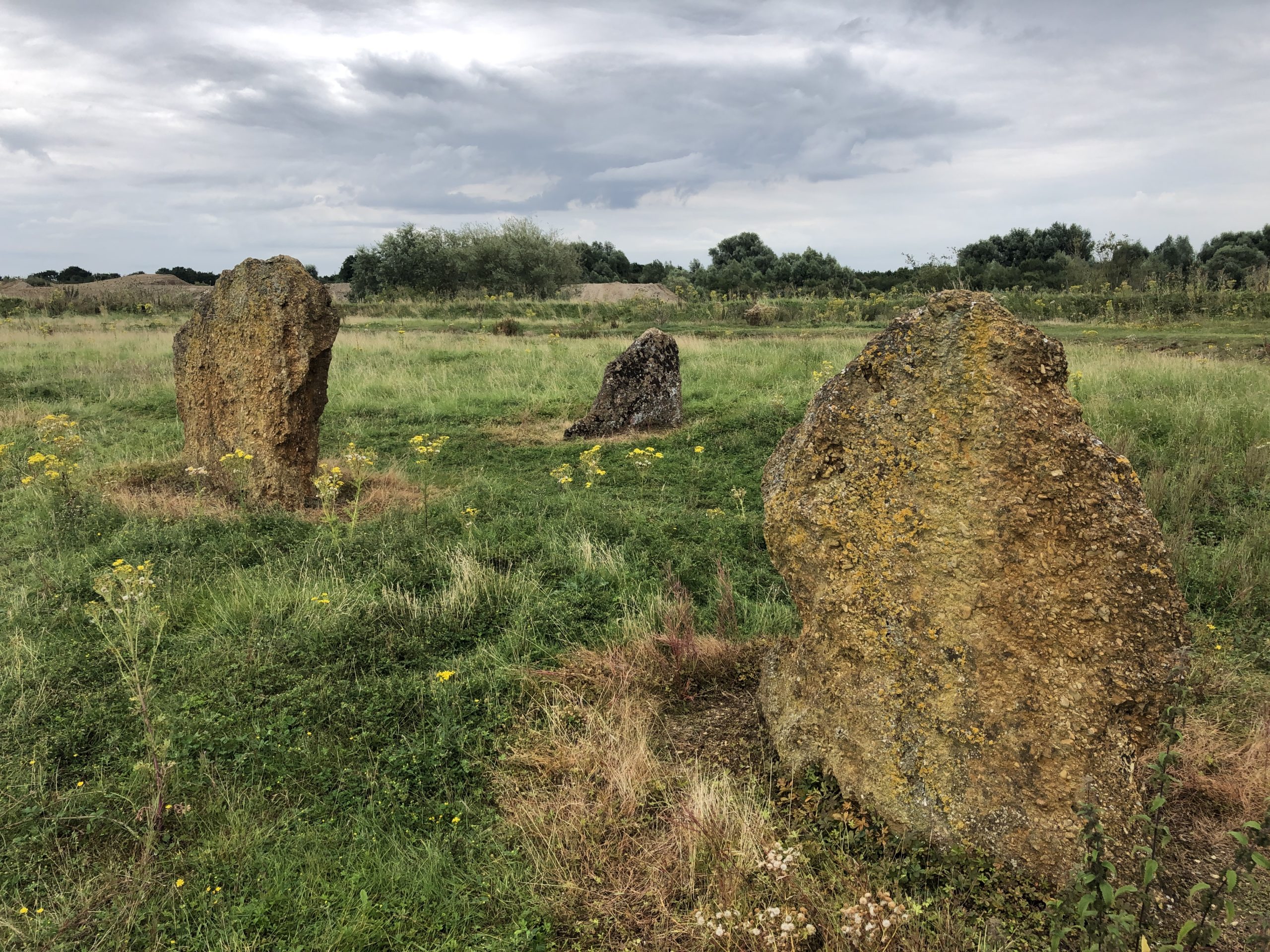
    In its early bronze age heyday, Devil’s Quoits comprised of 36 standing stones in a ring with a 79m diameter. Between the middle ages and the present all but one went missing. Today most of them have been relocated, rounded up and rounded off with 20 brand new quoits.

    There are no rock paintings, no visible engraving and, as on the overcast days we visited, merely grey stone with little to see.

    In the RPG franchise Assassin’s Creed, we come across a fantastical henge known as Devil’s Quoits.

    Thunder threatens, fragments of tribal design glow from the rock. As our avatar says upon completing a puzzle, there is a “strange energy here”.

    In search of their secrets, the Quoits have been energetically excavated several times since 1940. Many of the stones have been returned from their medieval berths and some twenty are brand new contemporary reconstructions.

    These blocks of conglomerate, unworn by age they retain an industrial pebble-dash quality which sets them apart from the remaining stones with their solid appearance and lichen coat.

    Wandering in and out of the stones, in a mode of spectatorship I had learned in art galleries and museums, I could not quite taste a full neolithic feast or hear the sound of collective percussion bounce off the surrounding ring of rock.

    I could however place my hand on the mossy stone. I imagined I could feel warmth. Perhaps even a pulse. I felt myself to be in the presence of sentience. Or at least that’s what I wanted to believe.

    I should have exercised a similar trial of faith with one of the twenty unlovely, more recent aggregations of small round stone and sandy clay.

    These too must have carried an exciting psychic charge: each one remains a vessel for the good intentions of a unified group of stakeholders from the local parish council to Oxford University.

    Our contemporary rituals comprise form filling and fund raising, aerial reconnaissance and the operation of a crane, sling and hoist. Who’s to say these energies are any less powerful than those of 4,000 years ago.

    To get here I navigated rural B-roads and defied the arrival of rain. I asked my young daughter to count the quoits. which bought me enough time to observe my fellow stone watchers. Photos were taken. Hikes were resumed.

    As a rambler like any other, I made a holiday destination of this monumental structure. But like a baffled viking avatar running back and forth I was also trying in vain to read the scene before me.

    Those new quoits, the sand-coloured replicas on all sides, appeared to insist that a stone is a stone is a stone.

    Meaning, in both cases, may reside in configuration rather than any inherent properties of the original quoits. The circle is a detail on an OS map now rather than a scene of gathering for purposes unknown.

    Devil’s Quoits can be found near Stanton Harcourt in Oxfordshire.

    Further reading:

    Devil’s Quoits on Wikipedia // Devil’s Quoits on Heritage Gateway // Devil’s Quoits on Archaeology UK

    Prehistoric parietal art, Uncategorized

    How French is Lascaux?

    June 27, 2019

    cheese and salami

    In a hypothetical word association game, I predict that food, the Eiffel Tower and the Mona Lisa would all get a mention long before Lascaux. The cave at Montignac seems French only insofar as a specimen of moon rock appears to be American.

    Today I was reading about the heritage industry and wondering just who might be the heirs to Lascaux. Surely it was once recognisably ‘French’. Indeed it is said to have been a prop in the post-war rebuilding of the nation. See Douglas Smith (2004) on the New Primitivism of the 1940s and the 1950s and the reconciliations of Lascaux, modern art and tradition.

    But now, sealed off, and replicated several times, the 17,000 year old cavern resides on a UNESCO list of Sites of Outstanding Universal Value. It belongs to us all, in theory. But this ‘world heritage’ status is ironic given that only a handful of scientists see Lascaux first hand.

    If we are heirs to the world’s first art, we have to put up with the idea that it is held in trust for us in perpetuity. Easier to inherit the intangible pleasures of French gastronomy, be you French or not, than the mysterious paintings of Lascaux, so hard to domesticate.