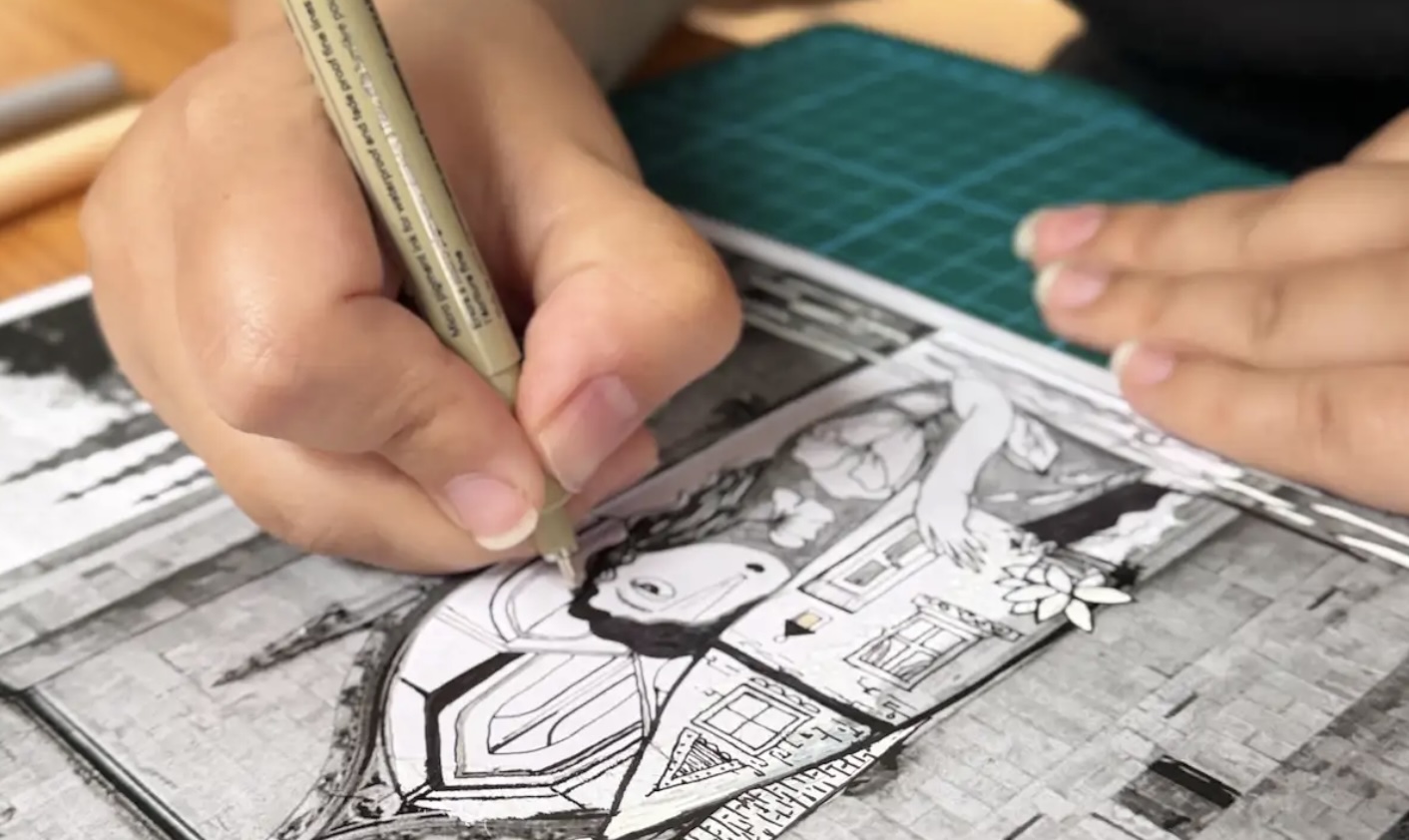
Star Khani’s project, The Weight of Arrival, has led me to reflect on my own arrival, here in Brighton. Her arrival here, from Iran, was characterised by close observation of buildings, many of which established residents no longer notice. Difference being, for me, I was not a migrant and somewhat privileged access to many of the city’s interiors, from flats of friends to pubs and cafes. I didn’t have any reason to dwell on facades and sidings in the way Khani has done.
In works which combine photography and illustration, she has dreamed ladders, plant tendrils, lungs and fairytale lodgings into the fabric of buildings which, for mysterious reasons, came to fascinate her as she walked around her new city. Black and white photos; monochrome ink; and a sense that she has gently put down imaginary roots, between bricks, through windows, under arches and on streets which in themselves have no interest in country of origin, religion or race.
The Weight of Arrival is hardly any weight at all, but rather a delicate intervention, albeit an insistent one. Some of these works stray into portraiture and the artist has documented her hands at work, which only highlights the artistry she brings to her adopted home. But as fine and precise these pieces remained, I was reminded of other works that have made deep incisions into buildings in literal ways.
The first of these works, which finds an echo here, is Conical Intersect (1975) by Gordon Matta Clark. Invited to Paris for a mid 1970s biennial, New Yorker Matta Clark was to make giant conical shafts in the sides of two 17th century buildings in Les Halles. In this way he questioned the public role of art and the politics of urban regeneration. The second work on comparable lines took place in Liverpool, in the 2008 Biennial. British artist Richard Wilson cut out a 10m glass and concrete disc in the side of the disused Cross Keys building and engineered the residual form to fit on a motorised spindle and rotate through 360 degrees. He called this Turning the Place Over. It too revealed an otherwise hidden interior and offered a heightened sense of the built environment.
These works may have been spectacular, and despite the fact I saw neither in person, I am a bit in awe. Khani, in a smaller city, on a much smaller scale, and in a low key manner, offers a quiet counterpoint to the somewhat macho antics of Matta Clark and Richard Wilson. Brighton is where she now lives and not a biennial venue awaiting big name activation. But in light of these site specific spectacles Khani has created a sensitive, intuitive and, for those who have seen it, equally transformative body of work.
The Weight of Arrival was develpoed as part of a residency at Fabrica, Brighton, July 2026.
