Browsing Tag: migration

    Brighton

    Star Khani, The Weight of Arrival (2026)

    October 29, 2026

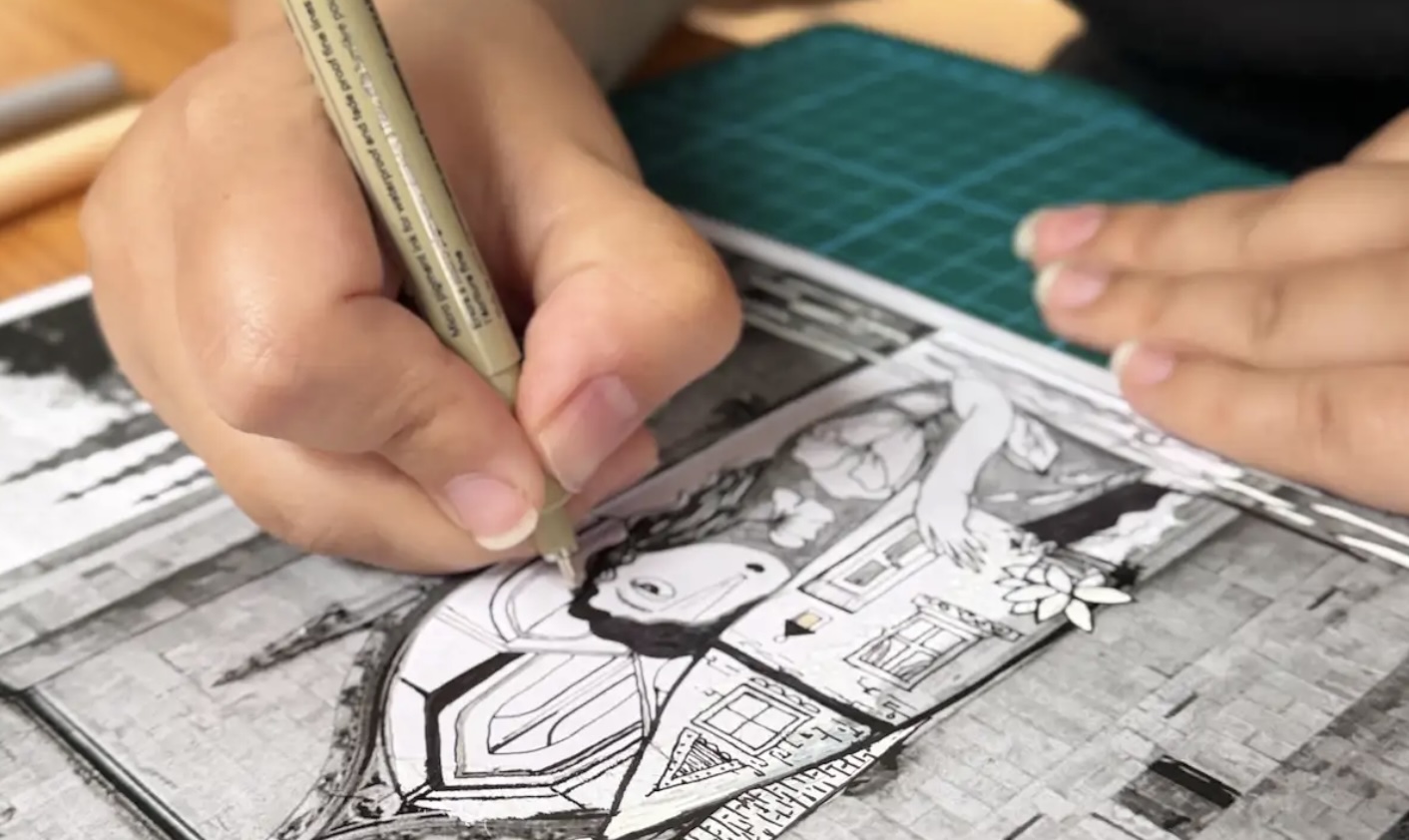
    Star Khani’s project, The Weight of Arrival, has led me to reflect on my own arrival, here in Brighton. Her arrival here, from Iran, was characterised by close observation of buildings, many of which established residents no longer notice. Difference being, for me, I was not a migrant and somewhat privileged access to many of the city’s interiors, from flats of friends to pubs and cafes. I didn’t have any reason to dwell on facades and sidings in the way Khani has done.

    In works which combine photography and illustration, she has dreamed ladders, plant tendrils, lungs and fairytale lodgings into the fabric of buildings which, for mysterious reasons, came to fascinate her as she walked around her new city. Black and white photos; monochrome ink; and a sense that she has gently put down imaginary roots, between bricks, through windows, under arches and on streets which in themselves have no interest in country of origin, religion or race.

    The Weight of Arrival is hardly any weight at all, but rather a delicate intervention, albeit an insistent one. Some of these works stray into portraiture and the artist has documented her hands at work, which only highlights the artistry she brings to her adopted home. But as fine and precise these pieces remained, I was reminded of other works that have made deep incisions into buildings in literal ways.

    The first of these works, which finds an echo here, is Conical Intersect (1975) by Gordon Matta Clark. Invited to Paris for a mid 1970s biennial, New Yorker Matta Clark was to make giant conical shafts in the sides of two 17th century buildings in Les Halles. In this way he questioned the public role of art and the politics of urban regeneration. The second work on comparable lines took place in Liverpool, in the 2008 Biennial. British artist Richard Wilson cut out a 10m glass and concrete disc in the side of the disused Cross Keys building and engineered the residual form to fit on a motorised spindle and rotate through 360 degrees. He called this Turning the Place Over. It too revealed an otherwise hidden interior and offered a heightened sense of the built environment.

    These works may have been spectacular, and despite the fact I saw neither in person, I am a bit in awe. Khani, in a smaller city, on a much smaller scale, and in a low key manner, offers a quiet counterpoint to the somewhat macho antics of Matta Clark and Richard Wilson. Brighton is where she now lives and not a biennial venue awaiting big name activation. But in light of these site specific spectacles Khani has created a sensitive, intuitive and, for those who have seen it, equally transformative body of work.

    The Weight of Arrival was develpoed as part of a residency at Fabrica, Brighton, July 2026.

    video installation

    George Barber, Fences Make Senses (2015)

    November 27, 2015

    Image: www.waterside-contemporary.com
    Image: www.waterside-contemporary.com

    It happened so fast. I heard a rip, saw a blur of yellow tarpaulin, and then saw the panicking youth. He dropped down onto City Road and began to sprint in the direction of Islington.

    The lorry driver, who was already on the pavement and could have come from anywhere in Europe, had a few words of advice for our new arrival. “Run, motherfucker, run!” he cried above the traffic.

    This little episode, which I witnessed today, on my way to waterside contemporary, has nothing and everything to do with the new video installation by George Barber, Fences Make Senses.

    In one scene from the timely film, a yellow lorry sits on a dusty road in the near East. Without giving names or dates, or even location, the VO informs us the truck was used to smuggle people.

    Fifteen would-be migrants got on board. Only two survived the journey. This truck is contrasted with a UK-based fleet of similar vehicles taking Kenyan green beans to British supermarkets.

    Barber made his name by sampling video footage in the 1980s. And needless to say the film here is a deft montage of reportage, advertising footage and abstracted views of the sea.

    What is perhaps less in character are the dramatic scenes, which offer Brechtian pause for thought; well-spoken British actors confront some of the problems facing those in the Mediterranean.

    In the most toe-curling episode they attempt to buy a boat from a huckster. It is little more than a child’s dinghy and they think it has a puncture. But what else can they (we) do?

    In fact, peril encroaches on all sides in the Hoxton space. Barber has installed the film in a no man’s land between land and sea. We sit on bales, amidst the flotsam and jetsam of steerage.

    The film speculates that, if we are still around in 100 years’ time, borders will seem weird. For the 50 million displaced people on our planet, such a time clearly can’t come soon enough.

    Fences Make Senses can be seen at waterside contemporary until December 12. See gallery website for directions and opening times.

    social practice

    Theodore Price, COBRA RES 1.9 (2015)

    October 30, 2015

    david rosenberg

    For those of you blissfully unaware, COBRA stands for Cabinet Office Briefing Room A, and despite first appearances the acronym has nothing to do with James Bond.

    COBRA meetings are convened by the Prime Minister in times of special crisis. And in the UK we tend to lurch from crisis to crisis; this in no way impedes COBRA’s evil-sounding mystique.

    But since 2013, whenever the great minds in the Cabinet have got together for a COBRA sesh, an ad hoc group of artists and writers has got together to respond to the response.

    This ongoing project, COBRA RES, is as shadowy than its inspiration, although artist Theo Price has curated seven editions. The latest is 1.9, a response to the refugee crisis in Calais.

    It launched in East London last night, in the form of a book of flash fiction (ie; stories under 1,500 words). The prelude to this was a walking tour about the history of migration in East London.

    Our guide was David Rosenberg (pictured), who knows all there is to know about radical politics in this part of town. He told us about the 1936 Battle of Cable Street as if it was yesterday.

    In this part of town, former synagogues serve as mosques. Church of England schools observe Islamic holidays. And blue chip artists keep it real with townhouse mansions in Fournier Street.

    He also filled us in on the Huguenots, French protestants who fled here in the 17th century to escape persecution and bring us the word, refugee, from the French refugié.

    We got to Spitalfields with its faux bohemian bars and eateries. With names like vagabond and vintage, these throw into stark relief the historic trials of local Jews, Irish and Bangladeshis.

    As David made clear: refugee and economic migrants are one and the same; incoming communities have brought us net gains; migrants in Calais have plenty to offer us here. So, why the crisis?

    COBRA RES 1.9 contains 20 stories and the half dozen I have already perused are great. But perhaps I should declare an interest.  I was a contributor; still, you can buy the book here!