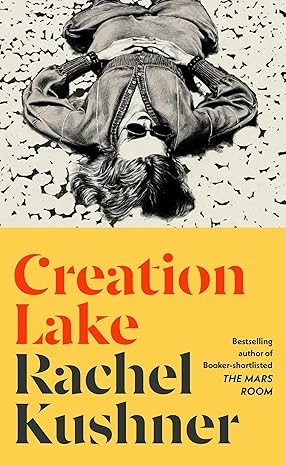
Rachel Kushner writes literary fiction that almost turns the pages for you. It is that engrossing. Her latest novel, Creation Lake, revolves around a reclusive intellectual who, having left civilisation behind to live in a cave, emerges now and again to send philosophical emails to a group of nearby acolytes. Could probably have his own Substack.
Named Bruno Lacombe, he fits the mould of a number of French intellectuals, one key difference being his living arrangements and the mournful faith he shows in our Neanderthal past. Lacombe is so fond of these distant relatives of ours that he affectionately calls them Thals and he gives an account of the interbreeding which has furnished many of us with a mix of early hominid DNA.
Due to the total darkness of his environment, Lacombe has trained himself to listen back through the ages. He claims to hear the Thal speak, during sojourns in the cave, and it is easy to believe that, when undergone for days on end, visual deprivation can lead to all manner of hallucinations and intuitions. Enticing both narrator and reader along, this speculative philosopher is able to hear the voices of multitudes on ‘cave frequencies’.
Lacombe’s travel is in a quite different direction from the new billionaire-driven space race; he has moved towards the centre of the earth. Kushner evokes the cave network as so extensive as to be almost un-mappable. It is inner space. Her novel is a manifesto for this journey inwards. Her cave ofers an uncertain promise to get us through these apocalyptic times.
The narrator of Creation Lake, Sadie, is hardly to be trusted mind you. She herself is engaged in corporate espionage against Lacombe’s neighbours. These so-called Moulinards have gathered as a progressive back-to-the-land commune, and are campaigning against coming efforts by big business to drain the water basin and shift the local economy away from local farmers and into the hands of Sadie’s paymasters.
Readers will be torn between their ecological ideals (we share them, right?) and the mild tension implicit in our understanding of the narrator’s aims. Her own sympathies, in turn, as an avid reader of Lacombe’s emails (she has his account hacked), tends towards a complication, doubt, and a softening of her own fairly apolitical position.
Not that she deviates from her mission. She has a job to do. She is an agent provocateur. She steers the activists in a violent direction as per her brief. And she gets involved, as spycops are wont to do, sleeping with commune members, seeking out Lacombe.
But as she does so she becomes drawn towards extinct peoples: not just the Thals but the historic local population of Cagots, who come across as noble savages to compare to the Thal, ie; not really savages at all.
Creation Lake is comic at times with a poised tone that delivers diamond sharp sentences that resonate in the darkness. Kushner describes things with great vividness, whether describing the timeless mood of a provincial village bar, al fresco lakeside sex, or the intrigue-filled atmosphere of the commune.
With the weaponry and communications at her disposal, the ruthless way in which she operates, and, somehow, her taste for beer, Sadie has a grit which appeals. This edge translates into many passages of prose which offer zero degree coolness in a way that both Don Delillo and Bret Easton Ellis have done in the past; the are in the same firmament as Kushner.
Like The Flame Throwers and The Mars Room before it, Creation Lake is composed of juxtaposed environments. Between those three novels, Kushner has taken us into the Manhattan art scene, a riot in Rome, a California state women’s prison, an L.A. lapdancing club, a drag race camp in Nevada, agrarian France, and here, of course, a commune for post-1968 social organisers.
The narrative appears to grow scene by scene. The plotting has been overstated in one or two of the blurbs on this book. Creation Lake is no thriller. But it remains immersive and compelling.
Fiction has a way of proposing indelible arguments with no need of evidence. Creation Lake leaves the reader with an impression of parietal works which functioned as stars maps, and impression of ancient, primitive sailors who navigate vast oceans in darkness.
That is a digression which stays with me. this book furnished me with a deeper feel for the depths of the earth and the depths of our past. It is fiction to create astonishment, transport us around in space and time, and offer fresh wonder at our prehistoric past.
Creation Lake is published by Vintage, pp.404
