<h1>Archives</h1>
    architecture, art nouveau, modernism, Uncategorized

    Toilet of Modern Art, Vienna

    December 13, 2011

    I’m not even going to mention the most famous toilet in modern art, but here’s another pretender to the throne, no pun intended.

    Hundertwasser was an Viennese architect. His quirky creations are a guide book mainstay, with their undulating floors and irregular windows. Coach parties love him.

    Just streets apart in the East of the city are the playful KunstHausWien, and a co-designed apartment block called Hundertwasser House. Both are equally tacky, equally welcoming.

    And I would defy even the most hardline modernist not to get sucked into the gaudy arcade opposite. It was so cold in late November, aesthetics were barely a consideration.

    This busy market is where you will find the so-called Modern Art Toilet. Which proved so irrestistable, I forked over 60 cents for a service I did not at the time require.

    Aside from some crazy tiling effects and cracked mirrors, it was not all that different from a less artistic toilet. But there was an option to wash hands in a fountain.

    Ahead of me in the queue were a delegation of elderly Italians. The turnstiles kept rejecting their money and they were exhibiting symptoms of toilet rage.

    This may not be exactly what Hundertwasser had in mind. But this art nouveau hippy does have an eye for the main chance. Upstairs you could buy posters and prints of his artwork.

    But say what you like about his nemesis, Adolf Loos. The more sober local architect, with his ‘devil’s tools’ (straight lines, according to Hundertwasser), has much more desirable merch.

    And his buildings do not pander to your inner child. Only streets away is a prime example built by his student Paul Engelmann and his friend Ludwig Wittgenstein.

    It’s a notorious fact that elements such as doorhandles took a year each to design. But still, one has no real desire to turn them and enter this villa of good taste. Perhaps that is the point.

    Is it me, or are these washbasins over selling themselves here?

    The door is locked. Come back when you’ve read Tractatus and make an appointment.

    Toilet of Modern Art can be found in the shopping complex opposite Hundertwasser House on the corner of Lowengasse/Kegelgasse.

    aggregation, contemporary art

    Found Objects 12/12/11

    December 12, 2011

    Clearly there has been a major art prize since the last Found Objects, but you’ve been spared any more links to it. Instead:

    • With great timing (both United and City crash out of Champions League) the BBC carry a slide show of a new show about Manchester after a speculative apolcypse.
    • Gabriel Orozco is the engaging subject of a Paris Review studio visit. He works in his kitchen, so where does he cook?
    • As Anselm Kiefer warns us, ‘there are only a few people who can say something about art’.  Great interview with Alex Needham.
    • Ignoring that sound advice I’ve sneaked onto a list of people making cultural predictions for listings site Spoonfed. Scroll down.
    • If you haven’t seen it yet, this bit of architecture crit from rapper Ice Cube is a joy. Give the man a BBC4 mini series.
    • More pre-seasonal good cheer is available from the New York Times. The paper interviews a comic book artist who also happens to be an asperger’s sufferer with no fixed abode.
    • And even more heart-warming fare can be found on the MoMA blog as they relay the runaway success of their new digital comments board.
    • But maybe we should get real.  Here’s some generally ominous war art gathered together by Will Brand on Art Fag City.
    • …and here’s some depressing photography about the oil business in Nigeria from We Make Money Not Art.
    • The panacea for all that is this wildly off-beam film about the internet made in 1969. Also from the ever-reliable @KathyKavan.

    contemporary art, painting

    Turner Prize 2011 @ BALTIC

    December 6, 2011

    They say no one likes a sore loser. And I’ve no doubt in person that after the winner was announced in last night’s Turner Prize, George Shaw was gracious in defeat.

    But shortly after Martin Boyce stepped up to claim the £20,000 award, it appeared to be paintings by Shaw which commented most directly on the evening.

    You don’t even need to see these works to get the picture. Titles included ‘The Age of Bullshit’, ‘Same Old Crap’ and ‘Landscape with Dogshit Bin’.

    BALTIC was heaving with metropolitan types. And it all at once seemed, no way could art’s most glittering accolade have gone to Shaw’s vision of dead end suburbia.

    But the Coventry painter offered something so different, one gets the feeling this year’s Turner was his to lose. Perhaps ‘humankind cannot’bear very much reality’, as Eliot might have said of the panel.

    Shaw’s exhibition was the last you came to after waltzing round the angular sculpture of Boyce, the heavy duty film rigs of Lloyd and the exploded soap factory of Black.

    His dozen or so paintings brought you back down to earth here. There were gray skies and graffiti many would recognise as humble origins not a million miles from their own.

    Too humble, perhaps, for a prize with international renown. So with those disgruntled titles, Shaw remains an outsider, his vision all the more powerful for not having won.

    The 2011 Turner Prize was held at Baltic, Gateshead on Monday 5 December. Thanks to sponsors Nokia for an invite.

    aggregation, contemporary art

    Found Objects 04/12/2011

    December 4, 2011

    A few of the least missable art links from the web this week. Peruse at will:

    • Here’s the most surprising thing written about art this week: Charles Saatchi on the vulgarity of the art world.
    • As if to make a similar point Miru Kim shacks up with two pigs for the duration of Art Basel Miami (as told by Animal New York.)
    • On the eve of the Turner Prize, you could do worse than listen to a mod-ish spotify playlist put together by nominee George shaw.
    • Sad news is they’ve fenced off Oscar Wilde’s tomb in Pere Lachaise. Good news is the BBC have interviewed the poet and wit’s grandson.
    • Corporate sponsors steer clear of historical shows in the US. Laura Gilbert says that‘s their loss.
    • The Walker Center in Minneapolis launch a new website. People in the world of online art appear to agree it is rather good (thanks, Eyeteeth).
    • 60s-style performance art meets contemporary RnB in this unholy YouTube clip found by Art Fag City.
    • A perverted but strangely beautiful twist on vintage erotica: Beautiful/Decay presents The Love Life of the Spumifers.
    • Meanwhile a new photography book uncovers a more banal world of sex. There aren’t enough Spumifers in the sex clubs of America.
    • Finally, settle down and watch this charming and poignant animation about the loss of classic high rise architecture in Chicago.

    Austro-Hungarian empire, funeral rites, traditional sculpture

    In Pictures: Kaisergruft, Vienna

    November 30, 2011

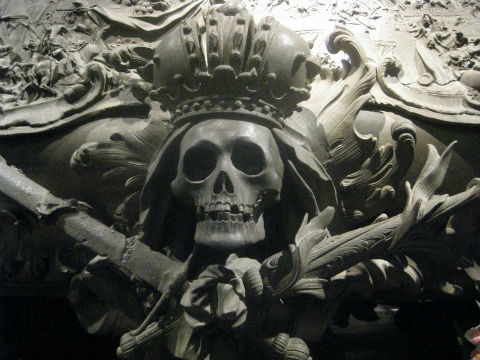
    An inscription reads Silentium and it is almost tempted to leave this post right there and allow these snapshots to speak for themselves. They are not a sight for chatter.

    But I wanted to share the impression made on me by these tombs in the Austrian capital. It was like encountering a fleet of dark limos or a batallion of war machines.

    Riding in these chariots to the afterlife are former members of the Imperial Hapsburg dynasty. They fill more than 100 ornate, unique sarcophagi dating back to 1633.

    The death rituals in this family would make those of, say, mine look as lightweight as cremation to the sound of Robbie Williams with a balled up pastel Kleenex.

    Hapsburgs cut out the heart and entrails of their deceased and buried them under two major places of worship. Only then was the corpse clamped in metal here.

    Towers in the sky characterise most cities today. But it may be crypts and cemeteries which provide them with gravity.

    Christ on the cross takes second place to a positively grinning skull with a broadsword.

    Maybe Robbie’s Angels would be an appropriate tune, but preferably a death metal cover.

    Another skull. You would think this sort of thing would be upsetting for the surviving family members.

    It was said the sun never set on the Hapsburg empire. Mexican influence, perhaps.

    Ornamentation piled on. Not hard to see what local architect Adolf Loos was reacting against.

    Shame about the scaffolding. But needless to say there were no whistling builders.

    The spookiest detail was this woman in a veil, wandering endlessly with the shades.

    Kaisergruft is at 1, Tegetthoffstrasse, Vienna. Open 10am-6pm daily.

    aggregation, contemporary art

    Found Objects 28/11/11

    November 28, 2011

    Welcome back to another round of art links from an exciting week on the Internet:

    • From the department of unexpected events, here’s news that the EU is planning to undertake its biggest ever funding drive for art and culture.
    • And here’s some more news that goes against the grain. Scientists have massively slowed up the rate at which Leonardo’s Last Supper is disintegrating.
    • Pop artist Gerald Laing passed away last week and you can read his obituary in the Guardian. I am really saddened by this as he gave me a great interview once.
    • If you need cheering up after that, you could read part one of Tyler Green on trees. In art, of course. These were prompted by an encounter with a van Ruisdael.
    • Next travel the world’s most remote byways in the company of Aaron Hobson. In his interview with Spiegel Online he talks about his project using Google Street View.
    • Hyperallergic reports on a photography show in Chicago which deals in the realm of crimes, both real and imagined. Sounds completely brilliant.
    • There’s another dose of vitriol from Alastair Gentry who reflects on the new Tacita Dean piece at Tate. I thought it quite good myself, but not so good I didn’t laugh.
    • New Art posted two videos featuring robots with a stirring introduction. One is funny and the other is elegant. You’ll know which is which.
    • Allow yourself to be entertained by a slideshow of the Shit London awards in the Guardian. I especially liked the depressing views from workplaces category.
    • Finally, a tumblr you may or may not have seen. It’s Ugly Renaissance Babies (via @electriclit and @alastairgenry).

    architecture, conceptual art, contemporary art, furniture design, galleries, intervention

    Adolf Krischanitz, Barhocker (1986)

    November 24, 2011

    With its dark, stained and somewhat splayed feet this stool looks solid enough. But it was still not clear that sitting there was permitted. It was, after all, part of an exhibition.

    It had its own plaque on the wall and, indeed, I was reading the very details relating to this piece, when I turned and saw what first I took to be an astonishing sculpture.

    Barhocker appeared to feature a hyper-realist old man with finely rendered grey hairs. It took a second to realise, this was in fact my gallery going companion.

    My father accompanied me on a recent trip to Vienna. But he wasn’t much interested in the meta-discourse on white cube spaces at the city’s famous Secession gallery.

    Instead he wanted to take the weight off his feet. And never mind the reference to Joseph Kosuth who is infamous for putting chairs into galleries.

    “You can’t sit on the art!” I almost shouted, pointing out that particular chair was an idea rather than a piece of furniture.

    Its designer is an Austrian architect who presumably made severeal Barhocker pieces to go with his rennovation of this world famous institution in 1986.

    This stool would have been the perfect place to gaze at the newly restored columns in the Hauptraum. They were once again clad in chrome steel and brass.

    Because in 1991, they were painted over for a show curated by Kosuth, whose best known work was a chair accompanied by a photo and a dictionary definition.

    His was not the only conceptual piece from the 1960s to involve a chair. Had this been a reference to George Brecht’s Chair Events, sitting there would have been just dandy.

    But that’s a lot of back story to explain to a weary relative why an inviting seat in a contemporary art show is probably a perverse conceit. It does sound foolish.

    DIE FÜNFTE SÄULE was a group show at Secession between September 9 – November 20, 2011. See gallery website for more details.

    contemporary art, public art

    Interview: Tamsin Dillon

    November 24, 2011
    Jeremy Deller's cross-track posters for Art on the Underground

    What might it be about a subterranean art commission which makes the imagination soar? Michael Landy, Jeremy Deller and Eva Rothschild are among the well-known contemporary artists to have taken their talents underground in recent times. It’s a gallery space you probably know, and chances are you have travelled on it.

    Art on the Underground is the long running public art project which brings the best art available to the platforms, stations and trains of the world’s oldest subway. And Director Tamsin Dillon reckons this tough brief is also an inspiring one for artists.

    “They’re interested in pushing themselves,” she tells me via phone. “And pushing their practice in a way that’s beyond what they might experience making work in a gallery situation.”

    Dillon explains that more than three million people use the tube every day, and admits that not all of those have an interest in contemporary art. However, artists do have an interest in them.

    “Many of the artists we’ve been working with have been very excited by the idea that the work that they’re presenting is going to be seen by a huge and diverse audience,” she says.

    Another challenge is the mass transit system running through the 270 “spaces” on the network. “There are huge constraints and obviously the operation of the railway has to take priority.

    “There’s the difficulty of how you as an artist might engage with a station building that’s got a very specific design to it. But also it’s filled with advertising, it’s got lots of signage, it’s got lots of things that are going to distract from an artwork – so it’s also how they will deal with that.”

    Perhaps no less of an impediment to the creation of new ideas is the extensive art and design heritage of the London Undergrdound. Typographer Edward Johnston and map designer Harry Beck are hard acts to follow.

    “It has definitely, over almost a century, built up a reputation for excellent world class design in terms of its architecture, the design of the tube map, obviously, and its font, so it’s all of its graphic output.”

    The tube has also long worked with artists on posters promoting tube use and the exploration of London. And yet the remit of Art on the Underground is more than promoting Oyster card top ups.

    “We want the programme there to enhance the journeys of the people,” says Dillon. “But instead of being decoration, it’s important for the programme to reflect London and reflect how important London is for contemporary art.”

    Even the front of the tube map, a seemingly straightforward canvas, is not without its challenges and rewards. It’s “really a travel tool – they are a very integral part of what people use to navigate the system and the network,” says Dillon

    “Now this series has become something which people expect to see both within the organisation and outside of it.”

    But having established the map covers, wrapped whole trains, clad stations, posted cross-track posters and introduced film to its repertoire, Art on the Underground has a well-earned track record.

    “We’re working on a really new strand of the programme that’s entirely devoted to artists’ film, Canary Wharf Screen, which will be starting in February next year,” reveals Dillon.

    This station was previously host to a 15x8m durational CGI film by John Gerrard. Not many galleries have a space to project work as monumental as that.

    But with the diversity of art already in place around the network, and the excitement of a new series of projects on the Central Line, Dillon is hard pushed to choose a favourite station.

    She does single out White City as “just a beautiful plain brick and glass modernist architecture”. What artist wouldn’t get inspired by a setting like that? Empty white cubes – who needs ’em?

    Written for Culture24.

    aggregation, contemporary art

    Found Objects 22/11/11

    November 22, 2011

    Vienna was fun, but more on that later. Here are some links I’ve been catching up with:

    • Check this photo on Hyperallergic and I’m sure you’ll agree, this woman really looks like a public menace. No wonder the cop is using pepper spray.
    • I may be late to this, but if police can use said spray ‘for fun’ it seems only right that others can too, given access to photoshop. See the Tumblr of the week.
    • While on the subject of global protest movements, C-Monster posts a couple of nice bits of street art from Tahrir Square.
    • Art historian John Berger has a piece in the Guardian. Marvel at the way his reading of the Degas/ballet show goes out on a shadowy limb.
    • Leonardo biographer Martin Kemp meanwhile compares the spooky new Salvatore Mundi to the (perhaps no less) spooky Mona Lisa. Great interview on Art Info.
    • The Independent asks if Damien Hirst deserves next year’s major retrospective at Tate Modern. Brian Sewell says, no. Martin Glover says, yes. That’s a maybe, then.
    • Cat lovers should enjoy this Q&A with painter Allison Schulnik. Why is she obsessed by the feline creatures? Aren’t we all.
    • This rollercoaster on foot is anything but pedestrian. Check out Phaidon for a new public sculpture by Heike Mutter and Ulrich Genth.
    • Hell hath no funniness like a woman scorned. Comic and artist Miriam Elia has a forthcoming show devoted to her break up with Martin Creed.
    • Excuse the shameless nepotism but Forbes is running a story about a board game and iPhone app designed by my brother. Find out why it might get banned.

    aggregation, contemporary art

    Found Objects 14/11/11

    November 14, 2011

    Internet: scoured, or at least partially. Hope you enjoy this week’s art-related links:

    • The world’s most expensive photograph reached £2.7 million at Christies. The Guardian seemed surprised it wasn’t a classic Kodak moment.
    • Meanwhile the world’s most expensive exhibition (surely) has already sold out its run at The National Gallery. The Independent offers a guide to crowd-survival.
    • Meanmeanwhile the Gerhard Richter show, drawing crowds south of the river, also  draws the tag “petty bourgeois nihilist” in London Review of Books. Like that’s a bad thing.
    • Modern Art Notes now comes in audio form and kicks off in style with an interview with a man who’s taken a bullet for art, Chris Burden.
    • That podcast led me to this YouTube clip of a more recent work by Burden, an astonishing sculpture called Metropolis II.
    • From busy roads to empty bus stops which are destinations in their own right. These Soviet bus shelters are all worth the fare.
    • Art Info have interviewed Jerry Saltz: this is pretty illuminating for anyone who thought there was money in writing about art.
    • The Telegraph report on a 9-year old who’s just sold 33 paintings for £100,000. So will he be the next Gerhard Richter or the next Jack Vettriano?
    • The same paper carries an epic slideshow with photography by Liu Bolin. This guy just kind of blends in, so don’t worry if you’ve never heard of him.
    • A five minute film on Edward Hopperpacks in a colossal amount of art historical nuggetry (on American Suburb X)
    • We Make Money Not Art look at the work of Heath Bunting, who can sell you a new identity in a briefcase. It’s 100% legal, guv.
    • And Huffington Post share a trailer for a forthcoming documentary about Ai Weiwei. This one’s, sadly, a cliffhanger.

    Thanks for reading and please note the next post will be on Tuesday 22 (following an imminent trip to Vienna.)