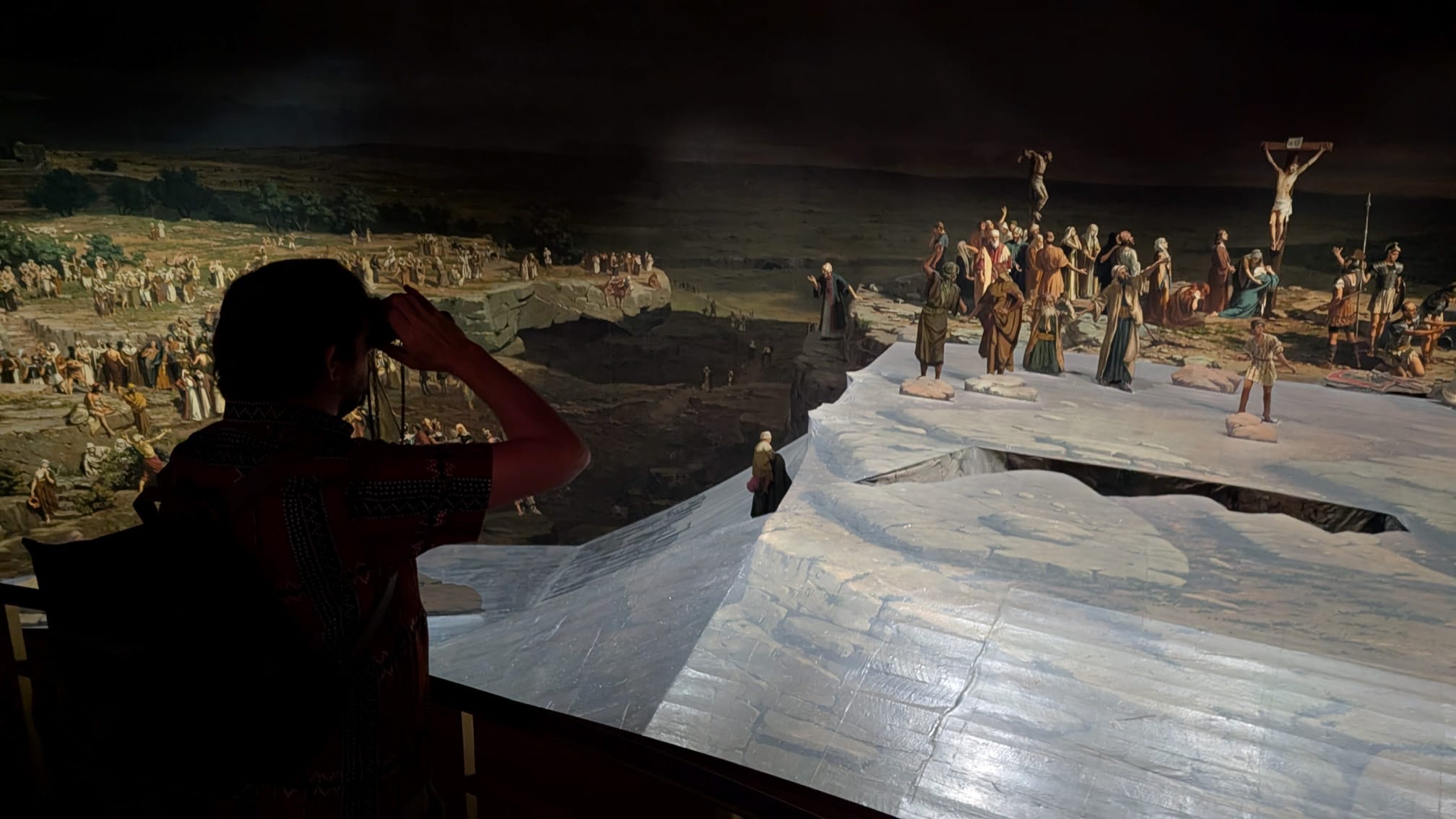
Thanks to binoculars, I could see Christ’s suffering all the more clearly. And I could spectate in comfort at all of the drama playing out at the foot of his cross. I could watch, as if I was an ornithologist, as Mary mother of Jesus and Mary Magdalene both suffered agonies. Or maybe as if at an opera, I could cast my gaze around upon a small crowd of be-robed locals; some of these were upset, some of whom were making numbers. I could focus, in my own time, on the various centurions as they presided over all this. The binoculars magnified the details, but they might have minimised the spiritual impact of this scene.
In a literal sense, we were quite elevated. The vantage point was a raised platform, 5m above ground with a 15m diameter. There was a guardrail, and a round, central table, provided with about twenty pairs of viewing glasses for public use. The biblical scene was but one slice of a 360 degree painting of Jerusalem in evil hour. Unrolled, this 14m high work is 110m long. It was the work of six artists, all seasoned in the panoramic painting genre. The resulting cyclorama was to be more than a feat of scale, it would also do clever things with perspective. Along with circular mural, it comprises a sloped foreground that suggests a drunken stage set together with two dimensional figures in the middle distance who add to the illusion of depth.
You could appreciate the attention paid to architectural detail and to period dress. Opposite Calvary an earthquake was slowly tearing the landscape in two. And since the crucifixion was but one of the attractions in the city of Jerusalem circa 33 CE, you could also allow your eye to linger on the sandy battlements of Herod’s palace, the flowing robes of middle eastern extras, and the sparse vegetation and orange soil of Judea. The skies were as dark as the presumable mood of God himself at this point. And in order to get all this dramaturgy right, the instigator of the cyclorama, a German painter by the name of Bruno Piglhein, spent a year in the region with his sketchbook.
In Munich, his references and notes were passed on to Dr Ernest Pierpont, an impresario of this kind of thing. Pierpoint recruited Paul Philippoteaux, a Frenchman with previous experience in historic battle scenes, to be the lead artist. You get a sense that this project, born in the pious impulse of Piglhein’s journey to the Holy Land, was soon subsumed by the excitement of the chosen 3D format. It was certainly not the first religious tromp l’oeil, but it was perhaps the first to become a touring novelty. Shipped to the Americas in the 1890s, it was displayed in Montreal before finding a permanent home in the small Canadian town of Ste. Anne de Beaupré.
It was here, rather than in a library or even a web browser, that I first came across The Great Cyclorama of Jerusalem. By happy accident we broke up our journey here, and parked up outside this monumental, polygonal rotunda that looked like a mosque reimagined as a circus big top. A glitzy sign next to it set the tone of a vegas motel and the box office and entry way had a warm, tobacco-coloured, carpeted ambience of a beloved but worn out cinema. The viewing gallery was reached through spiral stairway. And a local guide, with more interest in the New Testament than media archaeology, was on hand up here in order to direct our attention to the camels and the tents in the surrounds of, say, the residence of Pontius Pilate or the Garden of Gethsemane.
But this guide was to delight us by taking us into the underbelly of the construction from where we could circulate at ground level and get a better sense of the scale and of the architectural heft of the cyclorama. The canva was a heavy and durable Russian linen. Its smoky patina and the scaffold support,both suggested that the instructive capacity of the biblical scenery had extensive material and even machine-like grounding in this orchestral pit. It was a curious space, filled with bric-a-brac. Over the decades, for reasons unknown, tailor’s dummies and model fish, photographs and canvas swatches had accumulated here. Indeed, the exit was through both a new world antique store and a gift shop selling religious souvenirs.
This should not have been surprising. The cyclorama is next to the Basilica of Sainte-Anne-de-Beaupré, which is an important site of Catholic pilgrimage. Given the fact I have a keen interest in immersive art, to stumble upon a contender for the world’s biggest panoramas like this was a small miracle. We were pushed for time, so we didn’t pester Saint Anne for any health cures. Instead we spent twenty minutes wandering up and down the concourse for the town’s visiting rodeo. There were opportunities to buy stetsons, eat poutine, or join a midday line dance. But we got back in the car and carried on to Québec City.

No Comments