<h1>Archives</h1>
    conceptual, contemporary, installation, music, painting

    Review: Ron Terada – Who I Think I Am

    April 2, 2010

    Ron Terada, Soundtrack for an Exhibition, video still. Image courtesy Ikon

    Exhibition: Ron Terada – Who I Think I Am, Ikon, Birmingham, until May 16 2010

    A brief digression on Vancouver may be needed. Thanks to a generation of artists that includes Jeff Wall, the third largest city in Canada has become an unlikely art world capital. So Ron Terada has emerged from a local scene which is also an international brand.

    In the most comprehensive exhibition of his work to date we are greeted by this fact. A large highway sign facing the entrance marks out the cultural space with the words: Entering city of Vancouver.

    It is too literal to be taken seriously and comes with quote marks attached. A photo on the wall shows an original sign by the roadside on the cover of a book about art in the city. The image was also used for a group show poster, then for an ad, and Terada has put similar signs in gallery windows.

    The meaning of the piece gets more complicated at every turn, and the same could be said of all Terada’s work. Shifting contexts are a vital part of the experience.

    Another piece, Soundtrack for an Exhibition, is both a video installation and an LP. A darkened enclosure has been constructed where you can listen to the soundtrack and watch it spin on a turntable at the same time. Stacks of the eponymous record propped against the wall appear to offer the chance to extend the exhibition into your home.

    Even when Terada paints, he paints about painting. Jack is an extensive typographic work which reproduces the text of out-of-print book Jack Goldstein and the CalArts Mafia.

    Lacking recognition as an artist, Goldstein becomes a drug addict living without electricity or water in a trailer. Eventually he kills himself. There is a fierce irony about the inclusion of these slick acrylic panels in a show called Who I Think I Am.

    Ultimately, Terada is a conceptual artist from Vancouver with a hip taste in music who presents himself as a conceptual artist from Vancouver with a hip taste in music. Rest assured, that is more complicated than it sounds.

    Written for Culture24.

    contemporary, craft, installation, sculpture

    Review: Susan Collis – Since I Fell For You

    April 1, 2010

    Susan Collis, Enter, us (2009). 18-carat white gold (hallmarked), white sapphire, turquoise. Courtesy the artist and Seventeen, London

    Exhibition: Susan Collis – Since I Fell For You, Ikon Gallery, Birmingham, until May 16 2010

    There are 25 pieces in this show by Susan Collis, but if it wasn’t for a gallery handout and some helpful attendants, you could easily miss the lot of them.

    The walls do not look ready for art. Nails stick out, Rawlplugs stick in, and specks of paint sully the whiteness.

    So it is with some wonder you realise the nails are made of gold, the rawl plugs solid turquoise and the paint specks black diamonds.

    Cuts of MDF on the floor now seem to bear closer inspection. These are inlaid with silver and mother of pearl. The wood itself is cedar of Lebanon, walnut and holly.

    The full list of components is dizzying. A rough wall houses amethysts and sapphires, jet and coral, ebony and lapis lazuli. The handout reads like a shopping channel script.

    It is not just the value of these materials which seems at odds with their unlovely context – in truth Collis uses relatively poor grade precious stones and metals. More amazing is the workmanship has transformed the gallery into a work in progress

    Paint splatters on an overall and dust sheet turn out to be finely embroidered. A bent rail is coated in gold leaf. The boxy checked laundry bag has been coloured in with pencil and biro.

    In one sense the artist bestows amazing value on this detritus as she touches it all with art. But in another she is undermining the very worth of her own labour and expensive materials.

    From beginning to end, the work effaces itself. The first piece is a discarded screw made from silver and white gold. The last features discreet staples in the wall made from platinum.

    Perhaps the show stopper is a bucket which collects drops from a leak in the ceiling, by means of a hidden water pumping system. As with all work by Collis, you need to look twice. Even then, you may not quite believe your eyes.

    Written for Culture24.

    contemporary, kinetic sculpture, ready made, sculpture

    Preview: Laura Taylor – Speedboat Matchsticks

    March 29, 2010

    Laura Taylor, Untited. Photo © Iain Chatburn

    Exhibition: Laura Taylor – Speedboat Matchsticks, Surface Gallery, Nottingham, March 27 – April 8 2010

    In a gallery, it may be impossible for an object to become completely useless. Laura Taylor will strip away the functionality from her ready-made sculptures, only to find new purposes for each assemblage.

    Her raw materials are oddments of motorised scrap, dismembered toys, daubs of paint and hanging string. They don’t amount to much in isolation, but when built up into an “over-engineered apparatus” they take on new roles.

    Taylor’s playful art promises to entertain and engage, even if it only partially works in a mechanical sense. And while the objects might fail to do what they ought, a spirit of optimism runs through her reconstructive project.

    Speedboat Matchsticks is not her first experiment with function in a gallery context. In 2009 she produced a mixed media installation at Surface Gallery for their Open Show 2009.

    Her contest entry was called Something That Produces Results, Kulit. It resulted in her winning. What her latest works may give rise to is anyone’s guess.

    Written for Culture24.

    expressionism, outsider art, painting, poetry, punk rock

    Review: Billy Childish – Unknowable But Certain

    March 26, 2010

    Flags (in June's Pot) (2009). Oil on canvas. Courtesy the artist and L-13, London

    Exhibition: Billy Childish – Unknowable But Certain, The Institute of Contemporary Arts, London, until May 2 2010

    In a poem on the wall, we find that Billy Childish once wrote: “I am a desperate man who loves the simplicity of/painting/and hates gallarys [sic] and white walls.”

    Now that his recent paintings hang on the white walls of the ICA, one wonders where Childish stands. For more than 30 years he has, after all, played the role of outsider.

    The hallmark of his poetry, music and art has always been the rejection of fashion, so perhaps it was inevitable that a cutting-edge public institution should one day pick up on the results.

    In painting, Childish is famed for sticking with tradition. His work is expressionistic and raw. He offers the viewer flowers in vases, landscapes and outdoor portraits but, this being him, two of the latter feature a dead man.
    An oil painting of a dark figure walking up a snowy hill

    The oils are laid on thick and, when it comes to colour, Childish favours the putrid end of the spectrum. Yet the palette can shift before your eyes. In Man on Snowy Street, bright shades of lime and blue override a first impression of sickly greens and greys.

    Most of these brushstrokes carry the weight of long years of suffering, which are well documented in the copious poetry also found in this show. Chatham’s least favourite son still bears the scars of a brutal upbringing.

    Childish also has dyslexia and will leave the misspellings in his written work. It gives to his poems a mixture of pathos and humour they might otherwise not have. When he writes of late night “kabbabs” instead of “kebabs”, it somehow seems fitting.

    Music is perhaps this artist’s best-known art form, and one room is given over to his many recordings with about half a dozen band, including Pop Rivets, Thee Mighty Caesars and Thee Headcoates.

    The sound never strays too far from garage rock – his bands are as rough around the edges as his art and his poetry. Call it the punk approach, but it translates better onto vinyl than canvas or the printed page.

    Written for Culture24.

    China, contemporary, painting, video

    Preview: Lu Chunsheng and Jia Aili – Counterpoints

    March 26, 2010
    Lu Chunsheng, The first man who bought a juicer bought it not for drinking juice (film still) (2008). © the artist

    Exhibition: Lu Chunsheng and Jia Aili – Counterpoints, Rivington Place, London, March 31 – May 15 2010

    With the commission of work by Ai Weiwei for the turbine hall of Tate Modern later this year, contemporary art from China is very much on the capital’s cultural agenda.

    So this new exhibition at Rivington Place can only add to the interest. Londoners can be the first in Europe to see a film by Lu Chunsheng and a solo show by Jia Aili. If the two artists share a common theme, it could be technological bewilderment.

    The First Man Who Bought a Juicer Bought it Not For Drinking Juice is the clunky name of Lu Chunsheng’s 27-minute film, which features a grain reaper in place of a kitchen appliance.

    By combining documentary and fantasy, he demonstrates how a machine can come to wield a terrifying alien power over its creator, in this case a mechanic.

    Emerging artsist Jia Aili shares his compatriot’s intensity of vision, and his large-scale paintings deal with the emotional impact of a rapidly modernising society.

    Exhibition organisers Iniva have also commissioned a site specific work from Jia Aili for the window of Rivington Place. His response has been to recreate a masterpiece of Western renaissance art.

    But this version of Carravaggio’s The Incredulity of Saint Thomas is a disorientating mix of hurried brushstrokes and muted colours. If anyone still needs convincing about Chinese art, this may be the show to see.

    Written for Culture24.

    19th century, Denmark, painting, realism, romanticism

    Review: Christen Købke – Danish Master of Light

    March 26, 2010

    Christen Købke (1810–1848), View from Dosseringen near the Sortedam Lake Looking towards Nørrebro, 1838, Statens Museum for Kunst, Copenhagen© SMK Foto

    Exhibition: Christen Købke – Danish Master of Light, The National Gallery, London, until June 13 2010

    This is an exhibition in which each painting’s title is as precise as the brushwork. View of a Street in Østerbro Outside Copenhagen, on the Right ‘Rosendal’, in the Background ‘Petersberg’ is a case in point.

    The picture itself has the gloss and attention to detail of a still from a period drama. It is a leisurely street scene revealing Denmark to be a place of harmony and plenty. Yet the realities at time of painting, during the first half of the 19th century, were social unrest and economic collapse

    As in much of the work of Christen Købke a soft light picks out detail which may or may not be authentic. In Frederiksborg Castle, View Near the Møntbro Bridge, he has no qualms about airbrushing a too-modern 18th century staircase out of the scene.

    Elsewhere in Portrait of Naval Lieutenant D. Christian Schifter Feilberg he includes a small window, but the finicky touch appears reflected in the end of an epaulette.

    There can be no doubt, Købke was an idealist. Recent history, such as the Napoleonic Wars, may have ravaged his homeland but he responds with landscapes and portraits of meticulous calm and a warm, often rosy light.

    The only hint of trouble is found in his bold compositions. The Danish painter crops buildings and goes with unusual perspectives.

    In Roof Ridge of Frederiksborg Castle with a View of Lake, Town and Forest it is the sky which fills most of the canvas. But Købke’s skies, whether blank, white and eternal, or filled with solid, static clouds also belie the passing of time.

    Meanwhile, he paints the national flag, in View from Dosseringen Near the Sortedam Lake Looking Towards Nørrebro, with too much slow care for it to flutter.

    But this was in one sense Denmark’s Golden Age. The arts were thriving. Both Søren Kierkegaard and Hans Christian Andersen were then writing. These were the good times which Købke’s aspic-like pictures did so well to preserve.

    Written for Culture24.

    Artes Mundi prize, contemporary, drawing, photography, video

    Review: Artes Mundi 4 at National Museum Cardiff

    March 19, 2010

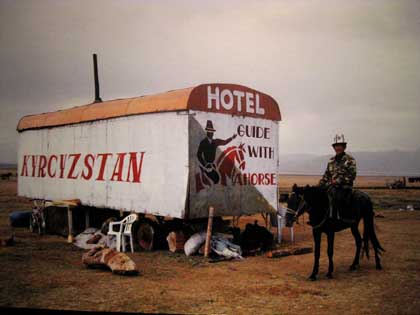
    Photographic work by Gulnara Kasmalieva and Muratbek Djumaliev

    Exhibition: Artes Mundi 4: Wales International Visual Art Exhibition and Prize, National Museum Cardiff, until June 6 2010

    Olga Chernysheva’s photos of a natural history museum in Moscow can now, by a strange quirk of fate, be seen in a natural history museum in Wales. But the scenes captured by the Russian artist are a world away from those encountered by visitors to National Museum Cardiff.

    The Welsh museum and gallery is a vibrant, welcoming, and forward-looking venue. While Muscovites can apparently expect empty lobbies, cluttered displays and sleepy attendants.

    Chernysheva’s scenes are static, monochrome and quietly amusing. Like all the shortlisted artists in the fourth Artes Mundi prize, she reminds us that the world has four corners, rather than one, and art can come from any of them.

    Gulnara Kasmalieva and Muratbek Djumaliev, from Kyrgyzstan, bring to light another alien environment: the barren trails which criss-cross their little known homeland to the West of China and the North of Afghanistan, otherwise known as the Silk Road.

    Their photographic subjects include a clothes stall, which makes Romford market look like Selfridges, and a one-room hotel shack with a horse parked in the cab rank. A multi-channel film shows local scrap metal dealers driving groaning trucks back and forth along the rocky roads in a relentless quest to make a living.

    International trade is also given attention by Fernando Bryce, with a focus on the very origins of global capitalism. The Peruvian artist is technically impressive, taking news articles and advertising materials from the turn of the 20th century and reworking them as illustrated pages from a comic book history of the world.

    His painstaking images and texts fill a sizeable gallery and render long-past events as fresh as his ubiquitous Indian ink, which also gives his grand narrative a fictional look and feel. Our current state of affairs seems all at once precarious, or at least arbitrary.

    Yael Bartana, Ergin Çavusoglu, Chen Chieh-jen and Adrian Paci are the four other artists in the show. So perspectives come from Israel, Bulgaria, Taiwan and Albania respectively.

    Such work from outside Britain and the US may not have the panache of, say, a cast aluminium lobster by Jeff Koons, but its concerns may be more pressing. It demands no less of your attention.

    Written for Culture24.

    contemporary, installation, text

    Preview: Jenny Holzer at BALTIC

    March 19, 2010
    For Chicago, 2007, 10 electronic signs with amber diodes. Installation: Jenny Holzer, BALTIC Centre for Contemporary Art. ©2010 Jenny Holzer, member Artists Rights Society (ARS), NY. Photo: Colin Davison

    Exhibition: Jenny Holzer, BALTIC Centre for Contemporary Art, Gateshead, until May 16 2010

    After more than 30 years making art from text, Jenny Holzer’s most recent work concerns censorship and the deletion of politically sensitive words and phrases.

    US Government documents relating to the Middle East comprise the source material for her new Redaction Paintings, a departure from the poetic slogans which form the bulk of Holzer’s work.

    Meanwhile Red Yellow Looming from 2004 may look like a classic LED piece by the New York-based artist, but again the text is taken from official memoranda.

    But fans of Holzer’s earlier work should not be disappointed by the show at BALTIC, which is her largest exhibition in the UK to date.

    The 22 bands of text which form Monument together with the words in luminous new floor based installation For Chicago are all drawn from her extensive writings and oft-quoted Truisms.

    Such trademark statements are equally bold whatever the scale, and have appeared everywhere from condom wrappers to building facades. Throughout her career, Holzer has rarely been afraid to say the unsayable.

    So it is alarming to find her come up against her limits at last, in the redacted texts of military ventures which have so far proved impervious to agitprop.

    Written for Culture24.

    artist-led organisation, studio/gallery space

    Feature: A Guide to Artist-Led Studio/Galleries in the UK

    March 18, 2010
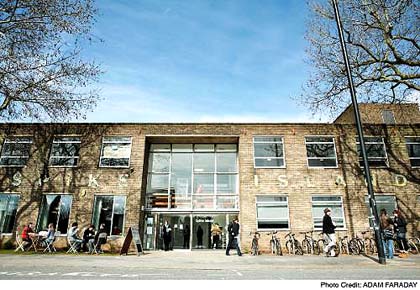
    Spike Island, Bristol. Photo © Adam Faraday.

    The pristine white walls of the gallery and the paint splattered chaos of the studio are no longer art world opposites. Studio/galleries have now joined the establishment but are artists still running the show?

    Many begin as anarchic, entrepreneurial experiments like the do-it-yourself-art-centre at The Old Police Station in New Cross, London.

    Revenue from 40 rentable studios, a cafe and supper clubs funds a programme of screenings, performances and exhibitions. They even have their own radio station

    But before long artists tend to organise themselves and, as in Nottingham, collectives form. With the opening of a new attic space at One Thoresby Street the city’s vibrant scene has a new hub.

    The building also houses Trade Gallery, 16 studios run by Stand Assembly, a project space run by Moot and The Reading Room, which does what it says on the tin.

    Put a bit more order in the mix and you get the co-operative model as found at Bankley House Studios Galleryin Manchester, where 30 artists are in residence.

    Painters, textile artists, photographers, installation artists, sculptors and ceramicists all share exhibition space, an in-house curator and visitors to the annual Open Studios.

    A bit of initial support from a local council can go far. Phoenix in Brighton have taken an unwanted city centre building and set up an artist-led charitable organisation.

    They offer more than 100 studio spaces, a gallery, space to hire for other purposes and a range of art courses for the local community.

    Reading Borough Council were also on hand to support Open Hand Open Space. In a former military keep you will now find 14 artists studios and an exhibition space.

    With ongoing funding from the Council and Arts Council South East, OHOS also provides IT resources and professional support to keep talent in the Berkshire town.

    The benefactors are private at Studio Voltaire in London, which the organisation says gives them the independence to take risks with the art and artists they support.

    40 artists are housed at their Clapham studios. While the public also benefits from a programme of exhibitions, commissions, live events and offsite projects.

    G39 in Cardiff is an artist-led space with collective roots which, thanks to added structure, gets most of its funding from Arts Council Wales.

    A team of volunteers help them stage between six and eight exhibitions each year. Meanwhile the Wales Artist Resource Programme offers studio space upstairs with additional funds from the Esmée Fairbairn foundation.

    At Royal Standard Liverpool, funding sources are just as diverse. Regional and city-wide funders for creative industries line up with two national Arts Councils to keep the sociable artist’s hub in business.

    There are 27 studios. A multi-purpose project space offers them a testing ground for new ideas. And the gallery showcases local, national and international artists.

    London also has five regularly funded organiations (RFOs) in the small galleries sector, two of which are Cubitt and Gasworks.

    Both studio/gallery spaces have both constitutions and an artist-led culture. Cubbitt is home to more than 30 artists and has strong ties to its Islington community who turn up for exhibitions, performances, screenings, symposia and talks.

    Gasworks meanwhile has 12 studios, with three reserved for international artists, and an exhibition space which hosts up to six shows a year. Here too there are screenings, plus workshops, seminars, events and an Open Studio. You can expect to find design and documentary filmmaking among the visual arts represented here.

    Both art and architecture are on offer at Art Gene in Barrow-in-Furness, where they supplement low level funding with commercial projects in the built environment.

    The artist-led agency has two galleries and five studios, two of which are used for international residencies. The remit here is research and regeneration rather than art for art’s sake.

    Research is also the name of the game at Wysing Arts Centre and they too have a trading arm, which sells the work of artists from the East of England.

    At any one time up to 30 will be using the purpose built studio set amidst 11acres of Cambrdigeshire farmland. Other funding comes from Arts Council England East and a number of arts foundations and patrons.

    But the commercial giant in terms of production and exhibition spaces would have to be Spike Island, Bristol. It has both scale and national presence with 80,000 square foot of space and high profile exhibitions.

    Along with two floors of studios, the former dockside tea packing factory now houses a busy café and branded workspace for local creative businesses, Spike Design. More than 200 people work and 300 people study in the recently relaunched building.

    The roots may be artist-led, the studio operations are still entirely artist-run and artists sit on the board of trustees. But in the words of curator Marie-Anne McQuay, Spike Island and many of the venues in this piece have a “mixed ecology”.

    Written for Culture24.