Browsing Tag: performance art

    contemporary art

    A Monastic Trio

    February 8, 2024

    Three good souls are performing, and improvising, their way through a weekday afternoon; large paintings are taking shape in the barn where they congregate. The trio combine music, movement and the slow application of bright acrylic paint. They address the canvas with gestural emphasis, and respond to one another with alacrity.

    For most of the time, they work away unseen, unsung, and unbeknownst to the majority of those in Oxford on this Wednesday. While university Fellows read and write, students sit in lectures, tourists come and go, and the remaining occupants of the city are at their day jobs, these three labour at something with little tangible value. It makes their process, and their product, all the worthier for that.

    The painted forms are abstract. The music freeform and dissonant. The dance is expressive and informal. The three make a noise and generate a real energy that can be felt beyond this cell of theirs. I hear it as I approach from the road and it feels like a calling. I push open the door and the mood in this hallowed space shifts, but only slightly. I feel accommodated by the group. A theme played by their oboe player lifts me. Their dancer and their painter may have stopped to listen to the sound of my entrance. I take a seat, feeling self-conscious, and begin to pen notes with an inevitable and unhelpful sense of theatre.

    I’m sure that it would have been welcomed were I to break into song, but I don’t want to overstate the blurring of boundaries between audience and performers. There is enough interplay without introducing this blogger as a rogue fourth element. The woodwind is provided by Christopher Redgate. The dancer is Lavinia Cascone, but she too paints. The visual artist, who cedes control, is Mark Rowan-Hull. He too moves, with slow poise, to the music. All three watch one another, listen to one another and vibe off each other.

    The paintings themselves emerge slowly as fingers dab and smear, as oil stick drips and arcs. Two canvases lean on walls, two rest on the floor. The pair without oboes are happy to wipe hands on one another and drum clean fingertips onto the canvas. They are happy to embrace stillness and move away from ostensible purpose, the production of artworks, to trace embodied arabesques around the paintings, drawing attention to the space they inhabit. The only rule, if you can call it that, is that the works, at this stage, have limited palettes: two are an infinite arrangement of blues, two are warm explosions of yellow.

    None of this would happen without the instigation of Rowan-Hull. This UK artist is many things: a mesmerising performer, a generous collaborator, and an expressive painter. What’s more, he is a member of Oxford University. And as might be expected from an affiliation with Oxford, Rowan-Hull’s work is steeped in high culture: classical music, contemporary dance, and art theory. He is also a synaesthete, so tones of music and tones of colour come together with intensity. This can be seen from the concentration with which he moves around this space, which is both studio and stage.

    Kendrew Barn, the venue, is an adjunct of St John’s College. Discreet signage directs you to an exhibition here which has run parallel to a recent conference at the College. During this event, art historians, musicologists and literary experts met to share perspectives on a most basic element of the painter’s art, gesture. But scholarly restraint was cast to the breeze on day two when Rowan-Hull staged an elaborate happening in a St John’s lecture theatre. On this occasion, Redgate and Cascone were joined by singer Maggie Nichols and artist/critic Matthew Collings, with electronica from Dr Emmanuel Lorien Spinelli. It is difficult to articulate the combined effect of these strong presences, suffice to say that one knew this quietly riotous, unfolding event to be Art with a capital A, because it fit into no other category.

    Back in Kendrew Barn, the footing is a little more stable. Next to the performance area is a room in which four static works line the floor, with a fifth propped against the wall. Gallery notes reveal that Rowan-Hull’s father was an Anglican Minister and there are a number of his clerical stoles, draped around the shoulders of the 2m tall wall-leaning painting. A vivid luminosity, which actually comes from overhead spotlights, appears to emanate from these paintings’ layered depths. Four works – two high spec digital prints on photographic paper and two hybrid print-paintings on Perspex – bring together rich blues, greens and reds as if in the glass windows one might gaze at in church.

    In this way the room sets an ecclesiastical tone which pits a 2,000-year-old religion against the latest developments in machine learning. In a paradoxical move, this show – which is after all entitled Gesture – includes two works here upon which Rowan Hull has not laid a finger. AI-generated clouds of layered colour are too rich for human hand and eye. Stained-glass meets a techno-futurist aesthetic and brings an overlay of staves, notes and musical notation together in a primordial vortex. The artist has briefed a computer to share his raw materials and then given the machine a presence in the resulting show.

    One might compare the musical notation to iron tracery, framing gestural fields of colour. It structures the abstraction. Close inspection reveals the written music to represent difficult avant-garde compositions, in rare time signatures and polarising octaves. Meanwhile, two pertinent quotes, offered as takeaway postcards, are drawn from two secular philosophers, Theodor Adorno and Hans-Georg Gadamer. I have neither the scope nor the expertise to explore these writers here, but the excerpts appear to get inside the notion of gesture as a movement that is natural and corporeal, yet also symbolic and even spiritual.

    In a third room, exposed barn rafters echo a single wooden seat, which resembles now a solo church pew. A giant cruciform hunk of rope which the artist found washed up on a Suffolk beach suggests a maritime take on the agricultural and nature-inspired works of the Italian Arte Povera group. An old-fashioned, starkly vacant pram, also a readymade, seems a nod towards dada, specifically Duchamp’s bicycle wheel. In these ways it emerges that the primary religion here is one we call art.

    Assembled for the contemplation of one visitor at a time they are situated between the churchy wooden stool and a large projection screen where a series of moving images play out. This short reel, set in a large, bare rural homestead, show Rowan-Hull engaged in forms of contemplative activity for a lone cameraperson and, in this show, a lone spectator. The title Empty House Studies, hints at the mood of isolation which the artist acts out. In more than one film the camera opens and closes on him daubing red paint on a staircase wall. It looks bloody, but it might be Farrow & Ball. Empty House Studies offers a silent, peaceable form of the Viennese art movement known as Actionism, but as if Hermann Nitsch was replaced by the composer and painter John Cage.

    Which is to say that this bijou exhibition engages with a lot of ideas, a surfeit of references, a plethora of theories. Yet at the heart of the resulting displays, which send the eye and the heart in so many directions, there is a shared performance in music, movement and paint. Redgate, Cascone and Rowan-Hull work away in a wordless realm and summon forces from across the exhibition space, channelling them into the form of paintings which are in no need of an audience, but which bear the impression of a collaborative dedication to art for unknown ends.

    Gesture: Mark Rowan-Hull ran at Kendrew Barn, St John’s College, Oxford, between 23 January and 2 February 2024.
    art activism

    Interview: Sofia Karim

    July 13, 2020
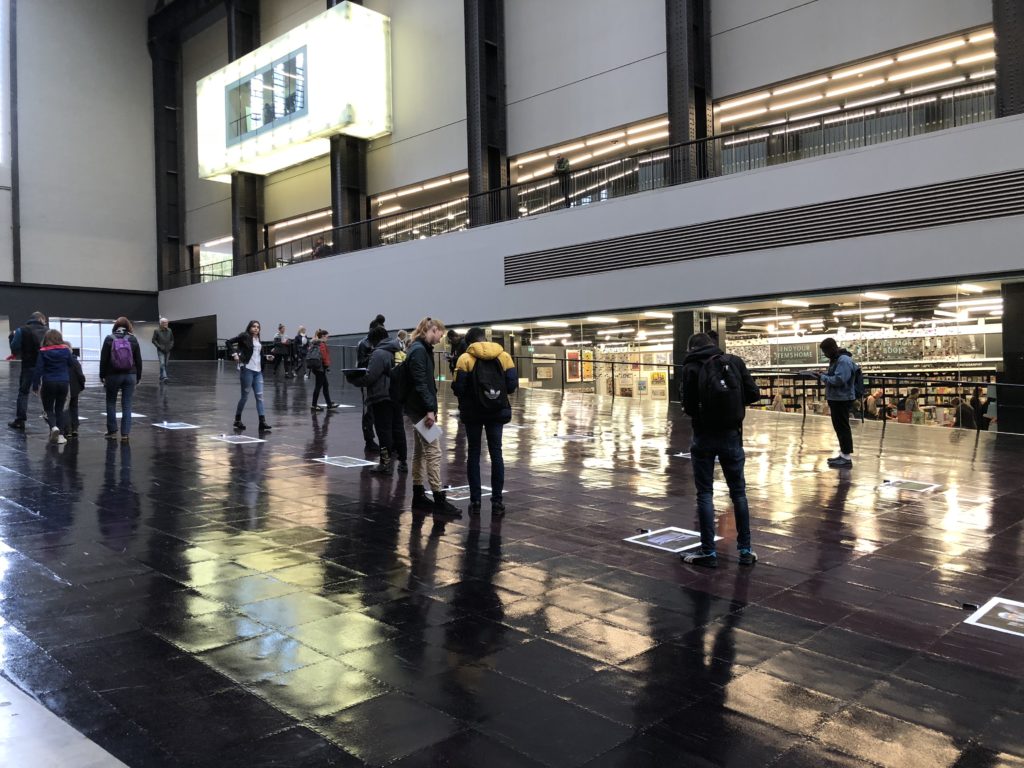
    FreeShahidul protest at Tate Modern, Turbine Hall, October 2018.
    Photo by José Carlos Mariategui

    In my last post, I detoured away from art to ask why the Indian Government was locking up students. Since then I’ve spoken to Sofia Karim, a Bangladeshi artist who has a few answers.

    “When I speak to people in the UK most people don’t even know what’s happening in India,” she says, “and they can’t even compute such a thing as fundamentalist Hinduism exists”.

    An architect by training, Karim became an artist activist by necessity. In August 2018, the Bangladesh government arrested her uncle, prominent photojournalist Shahidul Alam, and he spent 102 days in prison for drawing the world’s attention to the repressive violence of India’s neighbour. Tate Modern was instrumental in his release; when a friend contacted Tania Bruguera, the Cuban artist agreed to accommodate a Free Shahidul protest within the wider performance piece taking place in the Turbine Hall (her response to the 2018 Hyundai Commission).

    Karim talks with evident gratitude about the hands-off support an international museum such as Tate could offer. “Those institutions weren’t places that were for us, until then. I grew up in an Asian household where there was really nothing for me in those institutions but that experience changed my whole relationship with Tate and I love the way that they didn’t interfere as well.” She now speaks with a mixture of authority and urgency about the plight of dissenters in India. She is tireless in her activities on social media and fearless in opposition to the systemic racism of the Citizen’s Amendment Act (CAA).

    Karim finds it ludicrous that the young female students accused of inciting a riot could have done so. And is clear what the state calls a riot, was in fact a pogrom which targeted Delhi’s muslims. Perhaps more likely to blame were inflammatory political rallies, hate speeches, and terrifying racist lynch mobs.

    “What once was ostensibly the world’s largest democracy has steadily turned into a Brahminical Hindu-suprematist fascist state, with relative ease,” Karim points out. “The West,” she says, “is generally okay with Hindu fundamentalism because they have a common enemy, which is Islam”. Thought experiment: imagine if the nascent superpower in South Asia was Islamic.

    The artworld has nothing to say about caste oppression or the blood on the streets of Delhi, because thanks to sky high profits and culture washing, “they are part of the system of power”. But a more radical form of art – art as activism – could be found on the streets of Delhi, as part of a women’s occupy movement in the southern neighbourhood of Shaheen Bagh.

    Shaheen Bagh should by now be shorthand for the largest political women’s movement of our time. It especially interests Karim because most of the protestors are muslim women. In the West, few would expect to find this demographic on the cutting edge of art and activism. You know the stereotype, Karim tells me: “muslim women just sit in the hijab at home cooking for their husbands”. So another compelling facet to events in Shaheen Bagh is the creation of libraries, painting areas for children, and reading spaces for children. Karim: “They’ve created this safe zone for themselves in a very, very dangerous climate and it was just completely revolutionary, the kind of art that was being produced there. “

    Forgive the confusion around grammatical tenses: the movement from Shaheen Bagh is alive, but, thanks to Covid-19 and lockdown, the occupation has melted away; Karim’s plans for an art event in solidarity with Shaheen Bagh are also very much alive, but thanks to the virus, she is waiting for Tate Modern to reopen and the time to ripen. Her return to the fray and to the Turbine Hall is imminent as a result, as Karim plans to stage Turbine Bagh, a collective artwork and performance piece designed to highlight the growing fascist element in Indian politics and the violence suffered by dalits, dissenters and muslims alike.

    The Turbine Hall may be imposing and vast but Karim plans to make the message immediate and even festive. Her intervention will include choral music, dance, and a decorative ring of rice on the concrete floor. She explains: “There’s this very traditional form of South Asian art called the Rangoli or the Alpona.”  The circular designs are made in the morning and swept away in the evening, according to ritual, and usually by women. In Chennai, the making of a recent rice paste Rangoli, together with a few slogans opposing the CAA, occasioned eight arrests. She will also be printing work by a network of activist artists onto samosa bags, the type that are very commonly made out of newspaper or magazines throughout South Asia. The idea came to her when she found herself eating out of a list of court cases pertaining to unfortunate individuals against the Bangladeshi state.

    Supporting her in the Turbine Hall will be members of South Asia Solidarity Group UK, South Asia Students Against Fascism UK, and SOAS India group. The diaspora members, including Karim, are determined to use their privilege of safety to speak out for their homelands.

    “It’s very important to us; It’s life or death,” Karim says. “Our spaces for dissent have shrunk there. We’re at huge risk. So international solidarity is crucial for us.”

    I asked Karim who she’d most like to design a samosa packet for the project. “When my uncle was in jail,” she tells me, “I was just desperate to get a letter from him. I just used to imagine that world he was in. In my other work, I built architectural models based on my imagination and his memory. I used to imagine myself in that prison and seeing the lives of all those people. So I think I’d love to see a samosa packet with drawings of what life is like in that prison and what they’re are all going through.”

    The Indian government may be locking up students, but the guilt is squarely with those who would persecute muslims and oppressed classes: the writing is on the FB wall, the Insta feed, and a consignment of samosa bags soon to be found at Tate.

    For updates on Turbine Bagh and events in India, you can follow Sofia Karim on Facebook, Twitter and Instagram.

    video

    Phil Collins, dűnya dinlemiyor (2005)

    August 8, 2017

    Dűnya dinlemiyor is Turkish for The World Won’t Listen, which as you may know is a 1987 compilation album by The Smiths. At the time of release, the world was listening. The album was a chart hit.

    And that was just in the UK. As this work by artist Phil Collins reveals, the sentiment and the message of the album reverberated all the way from Columbia to Indonesia via Turkey.

    The Turkish installation of this epic project was filmed over several days in an Istanbul nightclub, to which fans of The Smiths were invited to sing along with a karaoke backing to the 18 track album.

    Thanks to the efforts of these volunteers, 30 years on, the audience for this work will be able to listen more closely to an album which Morrissey appeared to predict the world would ignore.

    He was loved him all the more for it. And his imitable persona has made the 2,000 mile journey from Manchester for this hour long film. A local, for example, performs with a back pocketful of flowers.

    More interesting than the inevitable Moz impersonators, are the millennials who take part in this exercise with good cheer. There Is A Light That Never Goes is joyous, rather than maudlin.

    In a similar vein, we have a hard rocking version of London and a version of Half A Person which is equally good for a giggle. It’s comedic to be a Turk singing about Euston station or the YWCA.

    When it’s not being funny or being awkward, dűnya dinlemiyor is a moving reprisal of a collection of songs that take one back to the 1980s, via this highly circuitous cultural route.

    The final track on the album, Rubber Ring, features a warning that until now was buried in time: “Don’t forget the songs that made you laugh and the songs that made you cry.”

    The singer is a middle aged goth who gives her all to the final performance of this artwork. Either she can’t let go of the music of The Smiths, or she has moved on and felt the consequences.

    This work can be seen in Now, Today, Tomorrow and Always at Towner, Eastbourne, until October 8 2017. The show is an Arts Council Collection National Partner Exhibition.

    dance

    Marcus Coates & Henry Montes, A Question of Movement (2011)

    October 5, 2015

    coates movement2

    The less seriously he takes himself, the more his audience appear willing to suspend disbelief. This – it seems to me – is the peculiar genius of artist, and sometime shaman, Marcus Coates.

    His East London gallery is currently showing a four-year-old film in which he visits ‘ordinary’ people in their homes or workplaces and, prompted by a question they’ve prepared, dances for them.

    No music comes between the artist and his private audience. Coates will remove his glasses, as if to put a check on his intellect. But this is his only concession to costume.

    He takes the locations as he finds them. There are unwashed dishes in the kitchen and discarded beer cans in the bedroom. There is an everyday drabness about the office.

    And no matter how comic you might find in the notion of answering questions through the medium of contemporary dance, Coates plays these performances quite straight.

    The only comedy comes within the terms of the dance, as he flings himself on the floor, stampedes on the bed, convulses on the carpet, headstands against the kitchen counter.

    His audience don’t laugh and neither do we laugh at them. It is to their unending credit that they take this project seriously and express their reactions and insights with great respect.

    And so Coates and collaborator Henry Montes (a dancer who has presumably coached the artist) bring out the best in their audience and demonstrate how open minded people can be.

    There is a sense that this experience has been at worst merely interesting and at best genuinely useful to the three participants, who face problems ranging from distractibility to indecision.

    Coates reminds us that dance is a primal activity. But there is a quietness to the way he presents it here, which implies that putting on a wild improvisation is the most natural thing in the world.

    (Whether your scene is a nightclub or a wedding disco, maybe take along one or two live issues to your next dancefloor. The first problem can no longer be, Do I look stupid right now?)

    A Question of Movement was commissioned by Siobhan Davies Dance and can be seen at Kate MacGarry, London, until 24 October 2015.

    film art, music

    Johanna Billing, Pulheim Jam Session (2015)

    March 21, 2015

    billing2

    To be fair, all years have some groundbreaking music to recommend them. But 1975 was a good year for both jazz and urban planning in Germany. Who knew the two could go together?

    In Köln, Keith Jarrett played an improvised concert, the recording of which was to become the best-selling solo piano album of all time. Note the quibbling over genre, which can be found elsewhere.

    Meanwhile to the North West of the city, a communal reform pronounced 12 nearby villages to have become a single municipal entity. Pulheim was born and in 1981 became a city.

    Now, thanks to a new 23 minute film by Swedish artist Billing, improvisation and infrastructure have been married up again: a pianist plays in a barn, while 50 cars stage a tailback on a one-lane road.

    Applying herself to the baby grand is artist and musician Edda Magnason. She offers a soundtrack to the traffic situation which begins with some tentative vamping and builds to an insistent riff.

    The camera loves her instrument, the workings of which are juxtaposed with the engines of the cars, as, when the queue gets moving again, one driver helps another with a jump start.

    But this is one jam you might not want to end, even if it takes place in a landscape as monotonous as it is continental, with fields of sleeping corn and power lines hung like staves from pylons.

    It is only once the cars grind to a halt that their occupants come to life. Passengers play with dice. A father reads to his children. Dogs are let out to chase sticks. It’s all action in a major key.

    Back in the barn, we encounter film crew, lighting rig and the impossible sight of men loading the Bechstein onto a removal truck belonging to ‘Piano Express’. Easy on the ears, the music plays on.

    Plenty more sounds find their way in; the road users provide ambient noise. And Magnason takes regular breaks, allowing you to think about what you see just as much as what you hear.

    But ultimately, if you give it time, this film will sweep you away. It is at once totally mundane and yet life-affirming. Billing finds music in every visual detail, from smokestacks to litter in the kerb.

    Pulheim Jam Session enjoys its premiere at Hollybush Gardens, London, until 25 April. Read my 2009 interview with the artist here.