Browsing Tag: photography

    Brighton, contemporary art

    Brighton in May: home is where the art is

    June 2, 2026

    I didn’t exhaust the possibilities for seeing art in this year’s Brighton Festival. But I was glad to have caught both the exhibitons here. If you saw either, let me know in the comments!

    Tender Exchange

    Hold a wooden heart and privately speak into it. Speak what is in your own flesh and blood heart. The wooden heart is anatomical in shape. Your own metaphorical heart impossible to locate. This exercise proves challenging. “It’s hard to say what’s really in your heart” I say to a project facilitator. “Yes, and it’s hard to know where to stop,” she replies, I take the trinket to a nearby tree and as I  stand below, in presumable communion with nature, I  commit a few words to a discrete inlaid microphone. Then I return the heart.

    The artist took it from me and placed it on a dock on a plinth where my innermost thoughts joined a sea of voices which echo from some dozen of these recording devices. I think my exact words were something-something-grateful, something-something-hoped for. As such, it was a generic, if ostensibly heartfelt, message. But on my way home I thought of many things I could have, should have, said to do justice to this quite twee but well-executed art work. Twee is not a dirty word, btw, if like me you grew up to the sound of 1980s tweepop.

    I moved around the ring listening to voices drift in and out of ear shot. Here was where prayers, wishes, confessions, confidences and secrets were exchanged and where the contents of your heart were offered up as tender in multiple senses. Currency for what I do not know. But to speak your innermost desires to an archive and hear them carried off by the breeze in this way was to feel like letting go. 

    Do my spoken feelings register with the universe or have I divested myself of them forever? Only time will tell. Tender Exchange now has knowledge of some of my intimate feelings, but reading news headlines later that day, I realised, we know very little about the human heart. 

    Tender Exchange was at Moulescoomb Place on May 16-17 2026. It was a Brighton Festival event by Becca Gill of Radical Ritual.

    Shadow Light: Songs My Brother Taught Me

    I had never seen a white cube as white as the Project Space at Phoenix looked during the recent show by Simon David Eden. And as the artist floated towards me, dressed in white, with a scarf you might wear to an ashram, he took on an inescapable aspect of celestial guardianship. 

    Shadow Light: Songs My Brother Taught Me is a show about suicide, both its acceptance and its  prevention. It pays tribute to the artist’s elder brother, who sadly took his life in 1976, at the age of 20. The musical siblings had played guitar together. And their old acoustic, painted white, strings all broken, lies in a hardshell case loosely wrapped in rusted chains; it’s as if the instrument has emerged in this hallowed space, Houdini-like by its own volition. 

    The life of this guitar extends to a suite of photographic prints, monochrome with the occasional dangerous red accent; the prints cluster upon all four walls accumulating ‘sold’ dots. If the public clearly wants them up on their walls, these serenely cubist studies (surely the eponymous songs inherited from Eden’s older brother) bear the weight of memory and silence. It’s a silence that not even the murmured conversations here can dispel.

    I too enjoy one of these low register chats with the artist. He tells me that the park outside (known in Brighton as The Level) was where his brother once worked as a groundsman. It’s a fact reflected in the two sculptural elements of the exhibition: as dried leaves, elm stumps, Sussex flint, which is as black and white as the prints, and a vicious looking saw blade. And because the artist’s late brother burnt his diaries, lyrics and notebooks, some ashy remains of bound paper are here in a readymade cage.

    Eden directs me to a poem on the wall in a quite priestly way and leaves me alone with it. In this poem the facts alone sing, in a concrete form text in which these lines stretch out and loosen as the white page behind them absorbs the pain like a healing hand pressed to a brow. I was moved, with a sadness hard to bear in close quarters. The artist did also say he felt his brother’s presence in the gallery. He has been brought back to us: a resonant gift for anyone who has known the loss of someone to suicide.

    Shadow Light: Songs My Brother Taught Me was at Phoenix Art Space between May 1 and 17 2026

    contemporary art, Uncategorized

    Interview: Paul Watson

    May 16, 2024
    Bacchanalia Beneath the Wind Turbines, Paul Watson, 2019

    An artist and I stand on the summit of Whitehawk Hill, atop the hidden remains of a neolithic encampment. He is dressed in black, and smokes actual cigarettes, as I might have expected. Beyond that I’ve little idea how this meeting, with one of Folklore Twitter’s dark luminaries is about to play out.

    The setting, a prehistoric site we both chose, is disappointingly nondescript. I had hoped it will channel some chthonic energy into the piece you are about to read. But for the time being, myself, and this leading online goth and Brighton-based artist, contemplate a mobile phone mast. He seems to love it!

    “I don’t believe in magic” he tells me later in the East Brighton cafe to which we repair. But, dimly, I had thought of Paul Watson as a serious occultist, with a suitably esoteric vision. His last published body of work comprises of shadowy charcoal figure drawings of gloomy naked models. These subjects looks so close to the relic-littered soil of old Albion. His drawings reference myth, pagan spirits, and a spirit of utter dejection which is very 2024. (Watson has an abiding interest in the English civil war).

    To further characterise his drawing, I would say that his figures are very inward. In charcoal, their bodies are pale or grimy, never warm or especially inviting. Whereas classical life drawing conveys a sense of anatomical fidelity, Watson seems to dispense with flesh in favour of bone. His men are stony or grave rather than vigorous; his women perhaps dented rather than curvaceous.

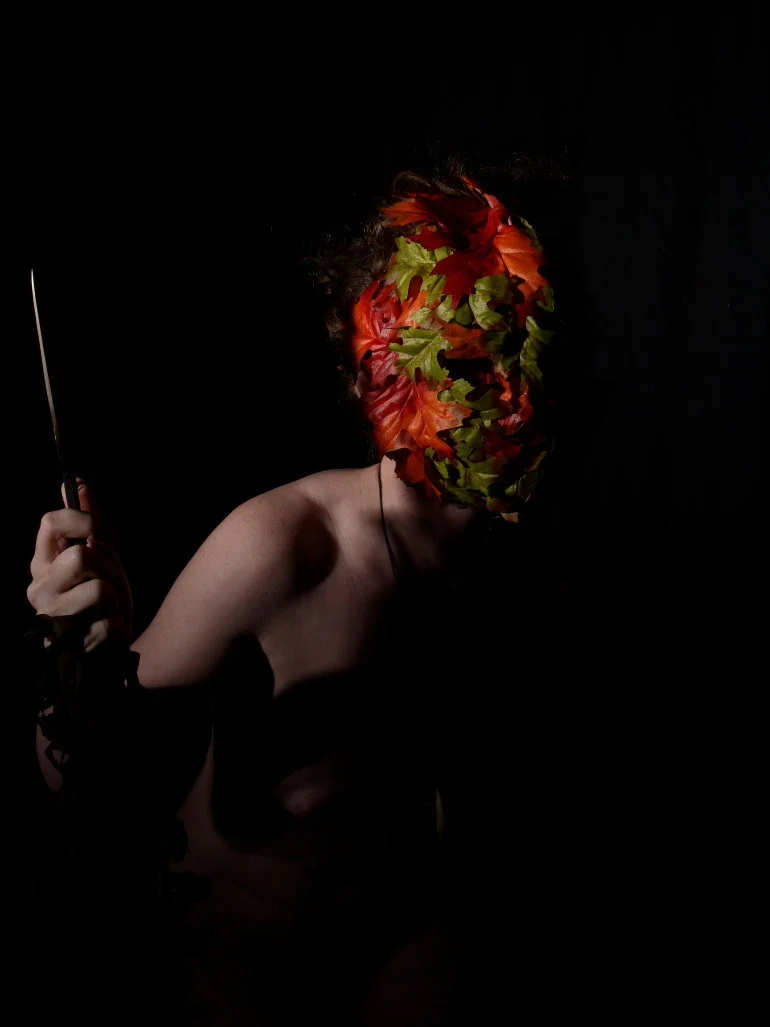
    Their environment can change; it is a background of midnight black in that series, a featureless sepia desert in the latest. Sanguine pencils, rather than charcoal, give his figures renaissance pedigree, quite at odds with the mood of fin de siècle Viennese expressionism. His photography, in which he shifts gears again, is stark and notable for the models’ otherworldly masks; and Watson makes these himself.

    Masks lend his sitters an air of atavistic power. It will amaze you, for instance, how a muzzle of ivy or an eye mask of oak leaves can imbue a stranger with great mystery and potency. You wouldn’t want to meet many of these photographic subjects on a dark night, and yet in their world it is always night.

    There is a vital intrigue here, because in person Watson is approachable, open and upbeat. For all the obscurity of the pagan rituals he seems to evoke, he offers complete transparency of means. He makes books, because these are more accessible (“People are in this country are far more comfortable buying books, than buying artwork. They know what to do with books.”).

    He also runs a detailed commentary on his practice at lazaruscorporation.co.uk. He is upfront about his paper, his pencils, and his process. If he is searching for a life model, you will read about it. Even his thoughts about blogging are right there, on the blog. He will also, endearingly, wear his musical influences on his artistic sleeve, having stayed true to a few bands from the 80s which I, for one, have been trying to forget. Perhaps unfairly.

    On the one hand he still inhabits an eldritch isle. His book England’s Dark Dreaming assumes the guise of a semi-mystical pamphlet. Watson took inspiration from ‘samizdat’ publications dating to the English civil war. “I started that after the Brexit vote,” he tells me, “and it was very much a cry of rage at the growing right wing presence in England”. Watson quotes the words of ‘landscape punk’ David Southwell, who claims that ‘reenchantment is resistance’. Watson concurs, aiming “not to view the world purely in materialistic terms and to use whatever is available to find wonder in the world.” Such wonder, he seems to say, will always elude the price tags of late capitalism. 

    On the other hand, he is unafraid of the light of day. “I don’t see any paradox,” he says, “between an enchanted world and a demystified process.” Watson might be horrified were I to present him as angst-ridden as, say, Ian Curtis. “I’m not interested in building on that whole artist myth of tortured genius,” he says. “I like demystifying the whole thing. I don’t think it takes away from the finished piece. I think it adds to it this whole thing.”

    How else, in the age of deep fakery, can you be verifiably real? Of his masks, for example, he says: “It was definitely not AI. It was crafted with glue and petals and wood – whatever I was using.”

    And here is the total artistic programme. When Watson is not coding software in his day job, he is working, as if from command-lines, series by series, on an attempt to create a vehicle or a lens to allow us all to imagine the unimaginable: namely the end of capitalism. Watson’s latest works are influenced by an unpublished, unfinished work of the late Mark Fisher, the theorist who is best known for saying the end of the world is easier to imagine than a working ideological alternative to the current Neo-liberal worldview. 

    Watson picks up: “I think that is true. It is very difficult to imagine something different from capitalism, so what I’ve been trying to do with Acid Renaissance [the most recent series – see above – which in fairness is warmer and lighter] is to break the imaginative chains by going into the mythic again and then start to imagine this future England almost like a social anarchist state”.

    In these sepia scenes of Leonardoesque cartoon we are confronted by details that Watson must hope we can take forward into that unimaginable future; here a laptop, there a wheelchair, in one, even and especially, wind turbines. Despite some deep historical references, Watson is clear he would like to effect change in the present. “I’m not interested in going back to the past, “ he says. “I’m interested in going to a post-industrial future”. Yet it is no pastoral idyll which the artist has in mind. “I’m fairly healthy but there are many people who rely on electricity and having the infrastructure of hospitals and things like that. So I very much don’t like these back-to-the-land fantasies. I think they’re fascist, because you’re essentially saying: we can kill off this part of the population. So I think you’ve got to imagine this post-industrial future which still does have things like electricity and healthcare”. 

    If that sounds difficult to imagine, perhaps it will indeed take a truly widespread, far reaching renaissance of an acid nature for us to collectively hallucinate what Mark Fisher’s idea of impossibility might actually look like on this planet of ours. In the meantime, we have Watson’s coming book.

    Whatever the future, there is something which the artist believes is essential to human expression. “I think there’s something very fundamental about creating images of the human body,” he says. He compels my attention with an image in England Dark Dreaming in which one of his mythic, future-past characters is making handprints on a cave wall. In this common palaeolithic act the body is implicated in “the very earliest form of art.” 

    Having spent six yeas of a research degree trying to put the term ‘cave art’ into question, I am not sure. But whatever the case it was grand to stand alongside such a thoughtful and committed contemporary artist on the site of an encampment dating back 5,500 years and look across our city by the sea.

    As Spring sunlight played on the water and the South Downs offered Brighton’s denizens their protection, we imagined being able to look across to the summit of Chanctonbury Ring by night and to see a bonfire. This mental journey back in time felt easy in the present company. Or was it a journey into the future? Reaching for my smartphone I took my own photo of the phone mast and we hiked back down the hillside.

    For more information on this artist, and to read his generous writings and/or view prints and books for purchase, visit Lazarus Corporation.

    Ritual, Part IV, Paul Watson, 2017
    Oak Leaf Mask, Paul Watson, 2014
    Whitehawk encampment, author’s photo

    photography

    Book: Photography After Capitalism, by Ben Burbridge

    February 18, 2021

    Publisher: Goldsmiths Press // Pages: 240 // Date: Dec 2020

    In 2011, a contemporary artist and a US council of war both made use of a series of photographs taken from satellite imagery. The artist was Mishka Henner; his Libyan Oil Fields appropriated the aerial views of petroleum extraction in that country which are freely available on Google Earth. The facilities appear high res, and, as has been noted, there are less interesting locations in the Libyan desert yet to warrant so much photographic detail. Henner was only the first to make use of these shots. The same year there was a US strike on some of these targets with some 110 Tomahawk missiles.

    The same year, another contemporary artist, Andrew Norman Wilson, got interested in the activities of Google, by filming employees in and around the corporate headquarters in California. One important role was to make digital photographs of books for Google Scholar, but those workers were only given ‘white badge’ status, and hence lost out on some of the privileges (free food, etc) given freely to their colleagues. Though his 11 minute film, Workers Leaving the Googleplex, has a wry connection with early cinema (See Workers Leaving the Lumière Factory, 1895), its more straightforward purpose is to draw attention what happens when photography becomes menial work.

    In Enjoy Poverty: Episode III, a 2008 film by Renzo Martens, we meet a group of Congolese wedding photographers who, instigated by the artist, attempt to boost their income by selling images of conflict to Médecins Sans Frontières. Their considerable efforts are rejected in what makes for a very uncomfortable scene in which the artist acts as broker with the client. And it appears that only Western photojournalists can be permitted to make reportage.

    What these three projects have in common, besides inclusion in the book Photography After Capitalism, is a concern with the more sinister aspects of contemporary imaging. From oil to systemic poverty via the digital academy, photography is everywhere. Artists who churn out examples of so-called poverty porn in order to condemn capitalism are not doing enough. It appears here that artists need to address photography’s role at the heart of capitalism, and Burbridge demonstrates page after page that fortunately many already do.

    But even that might not be enough. Critical art also enables left-leaning fans of critical art to feel that merely by consuming politically engaged art they are doing something. This issue is grappled with by many artists today. Yet even the high earning players in the art market have a critical edge, without which they would lose status and stock. It’s a problem. Burbridge does not call for the storming of the Googleplex, but he does agitate for more incisive photography projects and new social models which photography can facilitate.

    Renzo Martens, for example, has been instrumental in the establishment of a white cube gallery at a former plantation in Lusanga, DRC. Will it change much? The implication of its inclusion within these pages is that, locally, it makes a difference. And indeed once you’ve seen those pictures, and once you’ve read this galvanising book, you need never look at a photography exhibition at your own local white cube in the same way again.

    Photography After Capitalism documents the loss of innocence given rise to by ubiquitous images, the digital era, and mining for the components of smart phones. But the book also points to the experiences of photography, those projects of resistance, which might one day grant us innocence afresh.

    Purchase Photography After Capitalism from The Photographers’ Gallery Bookshop here.