<h1>Archives</h1>
    contemporary art, Regency architecture

    Pablo Bronstein: Sketches for Regency Living

    June 14, 2011

    There’s an elephant in the room at the ICA. In fact, the elephant is the room. The spiritual home of the avant garde in London is a well-to-do Regency building on the capital’s grandest street.

    That alone could have been a reason for industrial band Einstürzende Neubauten taking pneumatic drills to the floor in 1984, and why the venue chose to recreate this infamous gig in 2007.

    Pablo Bronstein responds to tradition in more constructive, dare we say, deconstructive way. The gentility of the place has been accentuated for his current show, or brought into plain sight.

    A tromp l’oeil mural in the style of an engraving turns the downstairs gallery into a 19th century plaza. And a dancer in something like period costume turns the plaza into a stage.

    But four empty plinths indicate the current function of Nash House. So the performance becomes a painful comment on any prancing around any of us may have done among the artworks here.

    So it seems that old fashioned buildings cast their occupants as old fashioned people. And yet there is much to be admired by this silent, ongoing performance which implicates the visitor.

    This dance was as erotic as it was mannered. Index fingers beckoned just as they pointed to the heavens. It was both as seductive and elevating as a visit to a gallery like this often can be.

    From time to time, the dancer would find herself in awkward positions. There were poses which looked difficult to hold. But if you engage with contemporary arts, you might relate to that too.

    The ICA will also be a difficult space to fill now Bronstein has brought home the middle class theatre of the whole affair. At least when the Germans played here, a decent builder could have sorted that.

    Pablo Bronstein: Sketches for Regency Living is at ICA, London, until September 25 2011. Check gallery website for details including their extensive co-ordinated programme of events.

    But in the meantime, you could check out this piece on trying to demolish the venue by Alexander Hacke in the Guardian, as well as this film of artists trying to do so on YouTube.

    aggregation, contemporary art

    Found Objects 12/06/11

    June 12, 2011

    Feel free to click through and enhance your day with one or more or all of the following:

    • Winner of the Golden Lion at Venice is the 24-hr montage of real-time movie clips by Christian Marclay. Here’s a temperamental link to a video interview on the festival website and an old piece from BBC News.
    • It’s been called the biggest installation of them all at this year’s Biennale. That’s right, it’s Roman Abramovich’s yacht. Full story in the Guardian.
    • The New York Times reports that £1.7 billion has been put aside to build an art gallery in Hong Kong, although it will have its own shopping mall.
    • Never cross an origami expert. A group of the artform’s leading exponents are sueing artist Sarah Morris for copyright infringement. Hyperallergic carries an eye-opening interview.
    • A mythic painting of the deposition of Christ has just gone on show in Rome, says The New York Times. The work of two artists, and one of them was Jack Kerouac.
    • This is great. In Seattle paper The Stranger, a music fan from Zimbabwe reminisces about his time in London, the year that acid house broke.
    • What was he thinking? An ex-public schoolboy tells Dazed and Confused about the hazards of photographing inner-city grime crews. Good pictures, mind.
    • Ben V has curated some essential film clips for a piece on the figure in contemporary art for C-Monster.net. But how would Chuleta explain Vito Acconci to her homegirls?
    • If you’re still reading,  here’s an interesting slide-show of boredom in art history put together by Slate.

    conceptual art, contemporary art, feminism, installation art, video

    Tracey Emin: Love is What You Want

    June 9, 2011
    Unrelated photo: Piers Allardyce

    In her much-talked about retrospective, the first piece of art is not by Tracey Emin. Nor does it seem much like a work of art. Despite the frame, it is clearly also a letter from her father.

    Halfway through the show is another work in which the art is hard to discern. This is a video piece called Conversation with my Mum (2000). It does what it says on the tin.

    It’s been noted elsewhere that Emin is the subject of Emin’s show. Most surely know by now most of her biography. And that biog is the message, however impressive the range of media here.

    There could be something in the water near Margate. Despite differences and the accusations of copying, the outputs of Emin and onetime lover Billy Childish appear to run parallel.

    First there is the confessionalism, an impulse you surely either have or you don’t. It cannot all be learned behaviour. Then there is the gesamtkunstwerk of painting, drawing, writing, film, etc.

    But the reason Emin is now the bigger player in the art world is not just because she moved into the conceptual arena but, equally, because she wears the former tendency better as a female artist.

    Personal statements and feminist art have gone together since (at least) the 1970s, when Mary Kelly made her landmark work about pregnancy and the early years of motherhood.

    Of course, we now have some real artists of autobiography, the non-conceptual celebrities who spin out their life stories in regular installments to an eager audience. It’s a thin line.

    You may point out that Emin can draw and has read some philosophy. The Exhibition Guide says so. But what a strange and interesting show this would be if she couldn’t or hadn’t.

    Love is What You Want is at Hayward Gallery, London, until 29 August 2011. I got the above image from Wikipedia Commons licence as photography was not permitted. But it seems to fit.

    contemporary art, outdoor sculpture

    Huang Yong Ping: One Man, Nine Animals (1999)

    June 7, 2011

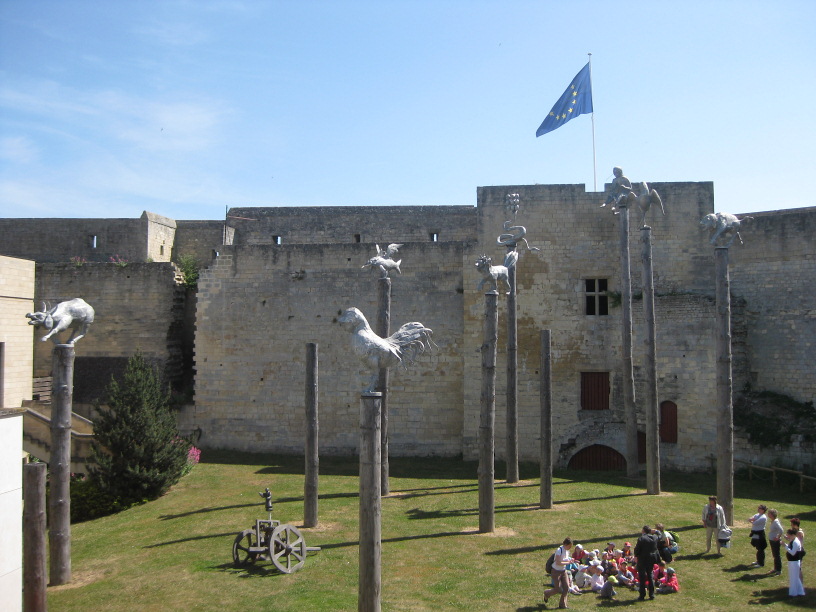
    Nine mythical beasts which presage disaster are on the march. A wagon used to measure time and direction lies broken on the ground. If you didn’t laugh, you might cry.

    The snake with two tails foretells drought (Currently in Europe, tick). The boar with a human head foretells floods (Singapore, tick). The eagle with one claw foretells epidemic (E.Coli, tick).

    These chimera come from a 2,300-year old Chinese book called Guideways Through Mountains and Seas. But any travelling party once with the installation here appears to have fled.

    A clockwork figurine built into the traditional Compass Chariot is the human presence suggested by the title. Traditionally pointing South, he now appears to send the herd West.

    This work was first shown in 1999 at the Venice Biennale. Those columns punctured the ceiling of the French pavilion just as they now infiltrate a Norman castle in Caen.

    But the millennial angst seems fresh enough. Not even these fortifcations can keep out the sense that trouble out there may come home to roost like a cock with a human head (foretelling war).

    And finally, as newsreaders say when it all gets too much, these creatures are cast in a bright and light metal, aluminium. The fish is a good sign. The monkey is ambiguous. It might never happen.

    This is one of four works in the sculpture garden at the Musée des Beaux-Arts, Caen. See gallery website for further details.

    PS: I’m grateful to an anonymous document hosted by the Académie de Caen for a key to the various creatures.

    aggregation, contemporary art

    Found Objects 04/06/11

    June 4, 2011

    You don’t have to go to Venice to be overwhelmed by the Biennale. Festival-related tweets have surely outnumbered the pigeons in St Mark’s Square. Here are some links from the floating city and beyond:

    • In the Guardian, Rachel Withers tells you more than most about Mike Nelson’s installation at the British Pavilion.
    • Writing on artnet, Jerry Saltz suggests national embarrassment might be the point of this year’s American Pavilion.
    • Meanwhile, Adrian Searle demonstrates a surprising propensity for clowning in this video report.
    • Elsewhere, it seems Salvador Dalí is still making work. The Guardian also reports on a shocking trade in what you might call zombie sculptures.
    • A Kick Up The Arts considers the economic health of the London gallery scene.
    • Hard-to-pin-down science related story 1: Jen Graves writes about artists’ newest toys in The Stranger.
    • Hard-to-pin-down science related story 2: Brain Pickings considers four cases of biology inspired art.
    • I am grateful to Animal blog for alerting me to the correct term for the practice of knitting based street interventions.
    • C-Monster.net highlights the mind-blowing potential of some Martin Kippenberger wallpaper.
    • Donald Judd is still exciting: a mash up of the Double Rainbow dude with a visit to a show by the minimalist sculptor (via/ Eyeteeth).

    contemporary art, installation art, Uncategorized, video installation

    Mark Leckey, GreenScreenRefrigeratorAction (2010)

    June 2, 2011
    Mark Leckey, Installation view, Serpentine Gallery, London (19 May – 26 June 2011) © 2011 Mark Blower

    The fridge looks nothing like my fridge. In truth it is more like a “dark mirror”, a “walled garden” or a “monstrous insect”, all comparisons made by an anguished, robotic first person voiceover.

    Manufacturers Samsung surely realise they are in the business of fabricating metaphors. How else could they justify a $1,799 price tag for a basic function which could cost you less than 100 notes.

    To make their point, they’ve painted it black. The 30 cubic foot machine comes in the same colour as a limo. Its resemblance to the monolith in 2001: A Space Odyssey goes without saying.

    Flanking Plasma screens build on this cosmic potential by juxtaposing the fridge with, at one point, a soup of fossilised sludge and, at another, the Northern Lights.

    Animated coolant passes through the condenser, narrated with reference to the moon and the sun. Like a cruel god, the machine is said to “torment” and “humiliate” the liquid.

    Our own hunger for the hi-tech is suggested by a cropped shot of the artist’s knees, rubbed in anticipation as lavish food shots fill the background behind the immobile, yet sentient unit.

    The fridge onscreen soon attains more presence than the fridge in the room. After 20 minutes, the real thing starts looking very finite against the gallery’s green screen infinity cove.

    Less affluent folk would normally come across this appliance on an advert or as a piece of aspirational product placement in a movie. Our present view from behind the camera punctures that.

    In fact the more reverence which smooth marketeers and satisfied customers give to their smart goods, the funnier this piece becomes. Because green screen action cuts both ways.

    Mark Leckey: SEE, WE ASSEMBLE is at Serpentine Gallery until 26 June 2011. See gallery website for more details. If you’re thinking of buying the fridge, it’s a Samsung RFG293HABP.

    chiaroscuro, contemporary art, contemporary painting, installation art

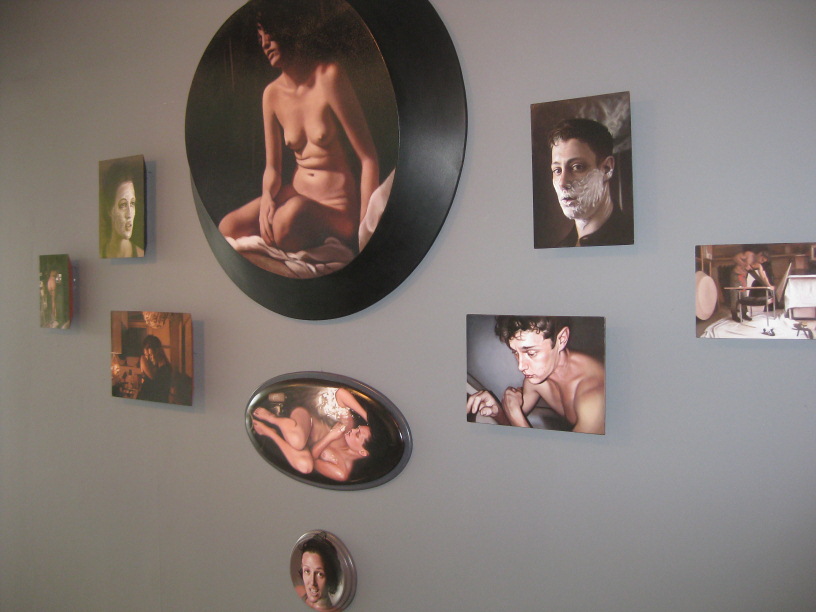
    Ben Ashton, 01:23 Monday, 13:30 Sunday, 13:04 Sunday, 23:39 Wednesday, 20:00 Thursday, 15:37 Sunday, 13:35 Sunday, 04:23 Saturday and 17:45 Tuesday (2011)

    May 31, 2011

    Although there may be no candles in these painted scenes, there is arguably candlelight. There is certainly romance and the echoes of a nocturnal interior by, say, Georges de la Tour.

    And in this light the vulnerable nudes, of which there are three, also call to mind Rembrandt. It may be worked out they are Ben Ashton’s wife. Other panels show them together and him at work.

    But whereas a gilt frame might invite you in to an intimate scene by a baroque master, Ashton has crafted three-dimensional wood panels which throw these domestic scenes into relief.

    Six of the paintings are on trapezoid blocks which look like inversions of sacred icons. Three are on roundels or plaques which look designed for the exterior of a building, not a gallery wall.

    These intimate scenes have not been casually thrust upon us. The rightmost panel shows the artist hard at work sawing and planing the rest of the piece. But he looks unaware of the end result.

    The leftmost panel shows his wife (we can work out the relation between them) bent over a screen. It is one of the nudes, lit by the glow of a laptop rather than a secretive 17th century candle.

    It is tempting to say that here it is the internet which has turned the modern home inside out. But painters have long revealed their interior life and the life of their interiors.

    In the flanking panels of this installation, Ashton appears to set the old and new technologies in opposition. Perhaps that is why in a self portrait in panel eight he looks so full of doubt.

    But since each element of this wall is titled with a day of the week and a time from the 24hr clock, it suggests he too embraces digital technology. Just as in panel three he embraces his wife.

    As this all suggests, the piece has a creeping sense of drama. Two of the most engaging panels show the pair denuding themselves with, respectively face cream and shaving foam.

    In other words, it is a soap opera. Where painters once used candlelight to heighten the pictorial drama, in a digital age they can (must?) use irony and art historical references.

    Ben Ashton’s work can be seen in group show Shifting Boundaries at Phoenix, Brighton, until 12 June 2011. See gallery website for more details. And read an interview with the artist on london art.

    aggregation, contemporary art

    Found Objects 28/05/11

    May 28, 2011

    Having been away for a few days, there seem to be some especially good reads this weekend:

    • Art event of the week was neither an opening nor an auction sale, but surely a blog post and the 300 comments it generated. Suffice to say, Jonathan Jones doesn’t rate Mark Leckey.
    • So much for the artistic boycott of China. In Modern Art Notes, Tyler Green reports on Chinese attempts to withdraw Ai Weiwei’s work from Museum of Contemporary Art San Diego.
    • Meanwhile on artnet, Matthew Bown talks about the medieval cult of relics. Quite a long read, but then it does tell you everything you might ever need to know about contemporary art. Really.
    • Two weeks until the Vorticism show at Tate Britain, but Craig Raine has already seen it. In the Guardian he suggests you don’t hold your breath, unless you’re a fan of the Monkees.
    • The axis of time has flipped, according to music journalist Simon Reynolds. Find out how/why/wtf in this thoughtful interview with Dan Fox in Frieze.
    • It’s turning into a musical week all round, as The Paris Review interviews the author of Our Band Could Be Your Life, Michael Azerrad. Great book, modest guy.
    • But today is also a sad day for music. RIP Gil Scott-Heron. Pay tribute by watching YouTube clips on Animal blog.
    • This week has also seen the obituaries of Leonora Carrington, a surrealist painter who led a remarkable life. Would love to see a biopic by Guillermo del Toro.
    • With captions like these, who needs pictures: an entertaining tour of the Milwaukee Art Museum by Carolina Miranda at C-MONSTER.net.
    • Knowing people who can’t find a nice family home in Brighton, it should be said this high security villa in Warsaw looks idyllic. Story by Kyle Chayka on Hyperallergic.
    • Finally, if you like short fiction, there’s a brilliant site called InkTears who will send you one new story each month. (Starting with one of mine, if you’re quick!)

    contemporary art, performance art, philosophy, video installation

    Plastique Fantastique, Impossible Diagrams

    May 27, 2011

    What to make of a flicker between a bandaged head and a face carved in a brieze block. Or an unshaven mouth which hi-jacks a news report. Or self-immolation illustrated as if for a kids’ book.

    Quite a bit happens in the Plastique Fantastique show at Grey Area. Not all is easy to describe and even less is easy to interpret. The entertainment above is on a reel called PFTV.

    On this channel a masked and spangly demon pops up, curses us, and with a voice garbled-by-vocoder intones: “There is not and never has been anything to understand.”

    It transpires Plastique Fantastique are into the philosophy of Deleuze and Guattari. The love of nonsense and invention of mad schemas with which to overlay reality may come from there.

    So a nearby video installation breaks down PFTV content into idiot-proof diagrams. Captions such as “You taste the object/ The object tastes you,” are still stupefying.

    Still, you should never dismiss the incomprensible. Two Plastique Fantastique performances, documented here, the ritual punishment of a victim by a band of futuristic savages.

    Hanging the man from his feet may be aim at inverting the status quo. But if not, these scenes still feel urgent and deep in meaning. It’s a feeling; there may be no point understanding it.

    Impossible Diagrams is at Grey Area, Brighton, until May 29. See gallery website for more details.

    Uncategorized

    Simon Faithfull, Limbo (2011)

    May 25, 2011

    In April this year the story broke that now ubiquitous iPhones and 3G iPads are recording details of everywhere their owners go, storing locations and timestamps on a secret file.

    This may not be a conspiracy, but it would seem to be one more step towards a transparent world in which privacy belongs to a halcyon past before surveillance technology and the world wide web.

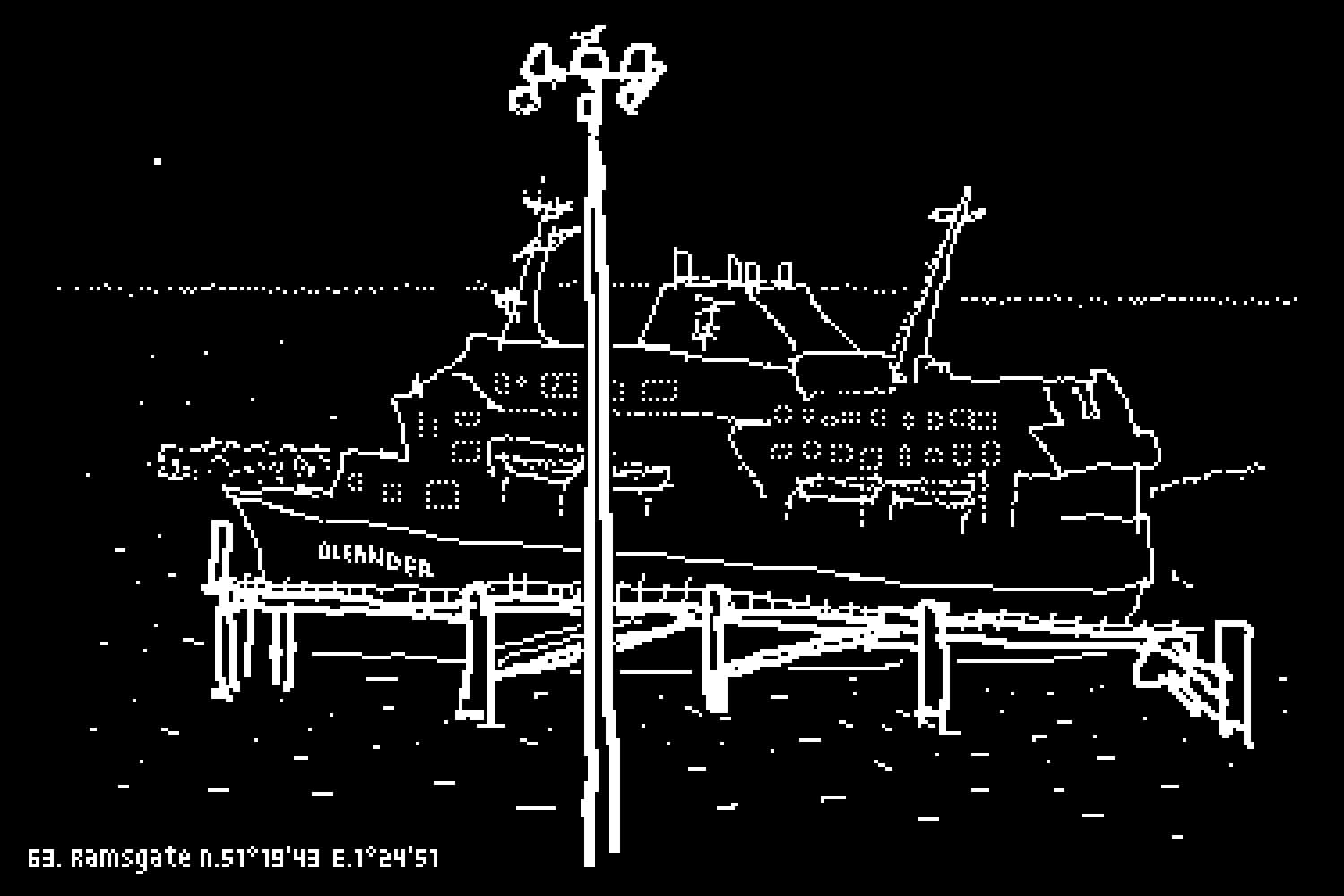
    But Simon Faithfull’s 10-year long project is located squarely where satellite positioning meets the mobile internet. Above you can see a rare example of a drawing with a geotag (bottom left).

    That’s what you might expect from a photo. And imaging technology also has a role to play in the laying bare of our lives. 1.85m CCTV cameras in Britain. Nearly 100 billion photos on Facebook.

    Considered together with Google Earth and Street View, this does appear to be a mad accumulation of empirical data. But the science of omniscience does have one major blindspot: subjectivity.

    Faithfull calls web-based artwork “an expanding atlas of subjectivity.” Unlike previous atlases, this one will therefore be infinite as no two viewpoints can really be the same.

    Nor can they be exhausted. The artist has stuck with the drawing software of an early Palm Pilot. It leaves wide empty spaces. It falls so far short of realism as to leave plenty to the imagination.

    And here is a perfect vessel for dreaming. Faithfull has just completed a four day residency on this cross channel ferry, giving it a mystique which even a sketchbook may have failed to.

    If you have an iPhone you can download a Limbo app and get fresh drawings from anywhere in the world. These too are secret files, clear if you experience the world, but invisible to your digital device.

    Limbo is the second 2011 web commission from Film and Video Umbrella. Check out some more of the drawings and get the app on the project website.