<h1>Archives</h1>
    Uncategorized

    Found Objects 03/10/11

    October 3, 2011

    Weekend shenanigans have led to a late and somewhat hasty collection of links this week. But nonetheless I hope you enjoy:

    • There are plenty of laughs here as Hennessy ‘Art Thoughtz’ Youngman makes an offline appearance at Museum of Contemporary Art Chicago
    • Pictures are well worth 1,000 words as this Wells Tower flash fiction, alongside paintings by John Currin, demontrates (thanks @hollyjdawson)
    • It’s RIP Evil as Slate magazine considers some recent advances in neuroscience which might themselves be put to bad ends
    • Tyler Green has done a spot of intrepid reporting and asks why there’s a missing Woman in the blockbuster De Kooning show at MoMA New York. It’s a bit of a shocker
    • Short but sweet: this animation tracks a viewer’s gaze over a work by victorian doom-monger John Martin
    • Speaking of doom-mongers, Edward Winkleman offers calming thoughts on Alessio Rastani, the trader who told viewers of BBC TV that Goldman Sachs rules the world
    • It’s always a pleasure to read Geoff Dyer. Here the novelist/essayist responds to a vision of Eden by Lucas Cranach the Elder
    • Artist blogs via Twitter Part I: serial drama as Corinna Spencer narrates a lost world of Victoriana, circuses and erotica (follow @Corr_)
    • Artist blogs via Twitter Part II: portraitist David Dipré slices open faces to reveal subjects’ inner abstractions (follow @daviddipre)

    Cluj School, contemporary painting

    Adrian Ghenie, The Hunted (2010)

    September 27, 2011

    He might not know it yet, but the subject of The Hunted is right where Adrian Ghenie wants him. This baboon has been cornered on a coffee table.

    That’s the kind of place you would expect to find a book about art. And indeed this photolike monkey fades into a black outline on what could be a cave wall.

    So…art’s connection with hunting dates back to prehistory. But who in these enlightened days or places would ever hunt a baboon. You wouldn’t eat the thing.

    Though if you were you a painter, you might want to study it. This painting is the most colourful in Ghenie’s show, as if the whole canvas is a simian face or backside.

    It may be out of place in what looks like a modernist home in northerly climes. But the artist has an understanding with the creature, who allows himself to be painted.

    A mix of found images and scraped paint make his work look like it is peeling away, much like the bark on those birch trees outside. What else might they peel away?

    Someone here has taken off his jacket and the baboon’s glare might even divest you of the trappings of civilisation. This painting brings out a primitive streak.

    Such an exotic encounter is surely what a gallery visitor is hunting for. And if they happen to be a collector, well, the monkey stands no chance.

    Adrian Ghenie can be seen at the Haunch of Venison London until 8 October 2011. See gallery website for a film about the show, but also check out this sceptical review on A Kick Up the Arts blog.

    aggregation, contemporary art, Uncategorized

    Found Objects 24/09/11

    September 24, 2011

    Once again, here are some of the more readable/watchable/listenable links from the past seven days:

    • “Freud’s cranium is a snail”: listen to a short radio 4 programme about the meeting between the founder of psychoanalysis and Salvador Dalí.
    • Tom McCarthy, in the Guardian, provides some intelligent appetite whetting for the forthcoming Gerhard Richter show at Tate Modern.
    • On Beautiful Decary, it seems Cubism is alive and well in these multi-layered collage portraits by Brazilian artist Lucas Simoes.
    • i-D magazine offers a taste of what LuckyPDF will be bringing to their slot at Frieze Projects next month, a short but sweet video.
    • For anyone who remembers a certain Grolsch advertising campaign in the UK, Jonathan Glancey tells architects to Schtopp! and slow down In the Guardian.
    • At Studio 360 you can listen to a 10 minute intro to the work of Chicano art movement Asco by Carolina Miranda: from vandalism to enshrinement at LACMA.
    • Q: What makes for a swinging bachelor art collector lifestyle? A: Everything in this story about  Frederick Weisman on Art Info (hat tip @TylerGreenDC)
    • As Facebook launches a new design, this piece by Zadie Smith in the New York Review of Books spells out the social network’s flaws (via/ @thebenstreet and @FisunGuner).
    • Civic art goes on eBay in Newcastle in the Guardian’s Northerner blog.

    contemporary art, film installation, Uncategorized

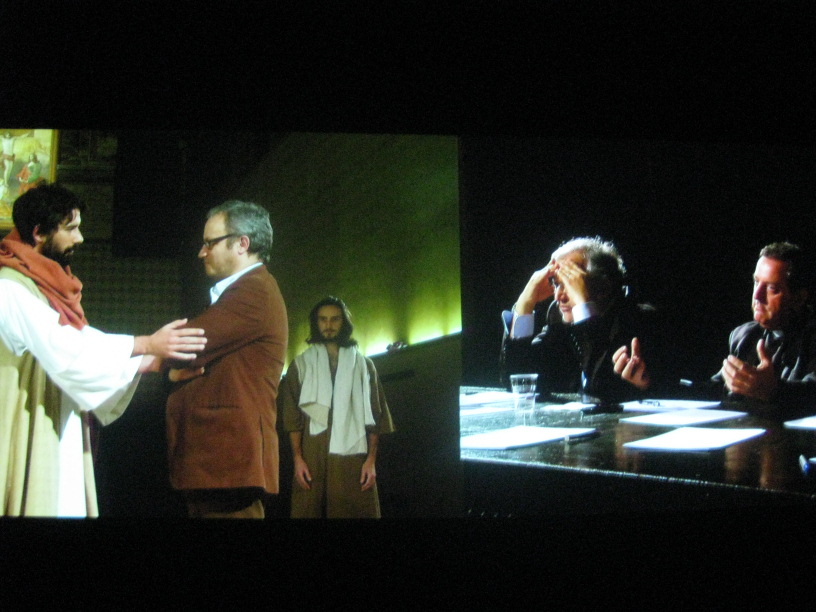
    Christian Jankowski, Casting Jesus (2011)

    September 20, 2011

    As with any 21st century talent contest, the three judges in Casting Jesus are impatient, cutting and at times cynical. They praise as well, of course, but not always with great sincerity.

    But unlike the panels we know from primetime TV, these worldly starmakers are a Vatican priest, a Vatican newspaper art critic, and a representative of the Italian Bishop Conference.

    Their snarky attitudes are thrown into relief by the purity which the 13 contestants are doing their best to exude. After all, the contestants are trying out for the role of Jesus.

    The studio setting is an 8th century hospital complex in Rome. A crucifixion can be seen on the wall. It is quite a sober place.

    But the search for Jesus is funny. Contestants overact, stagger under the weight of their cross or drop to their knees in a moment of inner turmoil.

    One soulful, serious man comes out the winner. And the judges tell him to lighten up. It seems a pity he really has no powers. Perhaps that is the pity of religion in general.

    No film, stage play or hit single results from this process. And as the winner is announced part of the film crew comes into view, so the second coming has been a media event.

    Or an art event. Because casting jesus is an artistic pursuit as old as Western art. Negotiating with clergical clients was also once, likewise, something of the essence of painting.

    Jankowski has brought this process out of the shadows and into the light. It reveals how art and film still matter to the Catholic church. But suggests television would serve them better.

    Casting Jesus can be seen at Lisson Gallery until October 1 2011. See gallery webiste for more details.

    Uncategorized

    Found Objects 18/09/11

    September 18, 2011

    Here are some of the best reads/watches/gapes from the last seven days:

    • What do we really learn from a £440 million memorial to 9/11? asks Tiffany Jenkins in the Indpendent.
    • A child’s eye view of Palestine gets banned from a Museum of Childrens Art in California. Read the story on Hyperallergic and do check the work out here.
    • In Mute magazine, artist John Russell assumes the character of a fly to write about laying eggs on Margaret Thatcher’s corpse.
    • It might be easier to accept a Swiss artist than a Swiss comedian, but Ursus Wehrli is both. Here’s some of his work for you to decide if it’s humour or art.
    • Pippin Barr has created an 8-bit video game of a visit to Marina Abramovic: The Artist is Present. Join the queue.
    • Even mediated by mpeg, 40 years after its creation, Five Car Stud by Edward Keinholz is disturbing. LA Times reports on its installation at LACMA.
    • Art Fag City links to a story you couldn’t make up. Kathmandu in Nepal is rocking to the last tune you would ever expect.
    • Could a corporation merge with a state? Artist Zoe Papdopoulou shows it could perfect for Cyprus and Intel (from We Make Money Not Art).
    • Hyperallergic does some terminological policing around the definitions ‘Primitive’ and ‘Tribal’ art.
    • A sense of entitlement comes early these days. See these photos of rich Russian children by Anna Skladmann (from Beautiful Decay).
    • Lastly, from the Independent, a candidate for least necessary show ever.

    Pop Art

    Richard Hamilton, The Treatment Room, (1983-1984)

    September 13, 2011

    Today’s sad news has prompted me to share an artwork-related anecdote. At Richard Hamilton’s Serpentine show in 2010 the central piece was a stark, cell-like hospital room.

    Next to the sort of bed patients get strapped down to was a stainless steel sink and if memory serves a bucket. Behind a glass shield to one side was a control panel (!). Over the bed was a TV monitor.

    Here could be seen former prime minister Margaret Thatcher, giving a speech with chilling conviction. It was hard to think of an environment with more menace.

    But art show launches attract all sorts. While looking at this disturbing work I became aware of a Barbour jacket type who was accompanied by a smaller, much older man.

    The former was providing a commentary for that latter and, also for some reason, for a portable voice recorder which he held.

    “This is a very optimistic work” I heard him say, or words to that effect. “You see the patient must have got better and got out of bed and walked off.”

    Anyone else might have said the patient had met a sticky end. Or would they?

    I’ve never come across a better or worse example of the subjectivity of art and I wonder what else this chap went on to say about the other works in the show.

    Because the meaning of later works by Hamilton, about say Israel or Iraq, was becoming even more explicit. Perhaps I saw for myself just why. Or perhaps that was a one off.

    Anyway, RIP Richard Hamilton, a man responsible for of some of the 20th century’s most resonant works of art. I hope we can remember whatever we think he was getting at.

    aggregation, contemporary art

    Found Objects 11/09/11

    September 11, 2011

    My abiding memory of September 11 is soul searching about the point of starting an MA in one of the bars at the University of Sussex. Not sure that we ever reached any conclusion:

    • Jerry Saltz, however, was collecting missing person posters and you can read his confession of sorts on artnet.
    • For all other 9/11 links, please see what Hrag Vartanian has to say on Hyperallergic. His experiences of the NSEERS program are quite shocking.
    • Certain New York residents aren’t at all bothered by this weekend’s anniversary, ie; the pigeons which appear in an NYT slideshow from photographer Andrew Garn.
    • With the approach of this momentous anniversary, Guardian columnist Jonathan Jones has been in two minds. First he says we’re all doomed. Then concludes everything will be alright.
    • Isn’t it about time someone explored the connections between socialist realism and glam rock? No, you might be thinking, but too late (via @artfagcity).
    • Meanwhile Karl Marx finds himself having to confront Andy Warhol in a chucklesome animation by artist Pedro Reyes. This comes courtesy of Eyeteeth journal.
    • Elsewhere the worlds of sociology and modelling collide in a plucked-eyebrow raising piece by Libby Copeland in Salon. Many do get out of bed for less than $10,000.
    • Edward Winkleman asks if prices keep going up, is the value of art going down, in a disturbing blog post.
    • The Independent publish an A to Z of postmodernism. D is for deconstruction. N is for New Order(!) And X, Y Z work out pretty good too.
    • It is intriguing that former Prime Minister Gordon Brown was so keen on this painting.

    Uncategorized

    Michelangelo Pistoletto, The Mirror of Judgement (2011)

    September 7, 2011
    Michelangelo Pistoletto, Installation view, Serpentine Gallery, London (12 July – 17 September 2011). © 2011 Sebastiano Pellion

    On paper, this is a place to come face to face with your greatest fear: a labyrinth in whose depths you will find monuments.pertaining to four major religions.

    But the deity or beast you are most likely to meet will be dressed in your clothes and looking back at you from one of the many eponymous mirrors.

    In one dead end a prie-dieu offers a chance to kneel and watch yourself observing this piety. But only in theory. Of course you can’t touch the art.

    Christian churches do not have many mirrors and with good reason. Watching oneself at prayer is the height of vanity. It is bad enough that others might also watch us.

    But perhaps self-consciousness is the very origin of morality. It could be we who sit in judgement on ourselves, and not the gods of Christianity, Islam, Judaism etc.

    So far, so clear and demystifying. But there are less finite elements to Pistoletto’s maze. A feature in the entrance/exit is a well-shaft which reflects a circular skylight.

    Peering down into this we see ourselves at a distance, fairly small against the slow-drifting clouds in the sky. (It was overcast and rainy on the day of my visit.)

    And we look up at ourselves from the depths of this well as if our reflected image could reach down and save us. To save us from what, exactly? Well, hell is also a mirror.

    A Charles Darwent review in The Independent puts Pistoletto in his Arte Povera context. Mark Hudson in The Telegraph flags up some interesting biographical details. Laura Cumming in the Guardian praises the works simplicity.

    This site specific installation can be seen at Serpentine Gallery until 17 September 2011. See gallery website for more details.

    aggregation, contemporary art

    Found Objects 04/09/11

    September 4, 2011

    How was your week? Mine was all the better for finding these 10 links:

    • Christopher Hawthorne in the LA Times reports on boom time for skyscrapers. To quote from movie Life Stinks: “Gentlemen, you’ll never know how much this project excites me.”
    • And as we approach 9/11/2011, at least one bit of reportage now looks like a clever piece of photoconceptualism. Jonathan Jones discusses Thomas Hoepker in the Guardian.
    • This guy’s got an interesting ‘practice’. The BBC interviews Lee Hadwin, who makes art in his sleep (hat tip to @artcoholic).
    • It’s now a book, a play and an exhibition. But the patricidal life of Richard Dadd still wouldn’t make a good game of family charades. Arifa Akbar writes about him in The Independent.
    • What happens when you auction cash as art? Find out in this Art Info story about Australian artist Denis Beaubois.
    • Charlotte Higgins interviews painter and writer Alasdair Gray, and the Guardian plays it for comedic charm in the resulting video.
    • Speaking of comedy, here’s a story about the German man who’s rerecorded every single Beatles album auf Deutsch.
    • Flavorwire carried a popular list of 30 artist-on-artist put downs from the renaissance right up to the very present day. As they say, harsh.
    • David Bowie’s Space Oddity has been turned into a saddening children’s story by Andrew Kolb. Read it and weep at Comics Alliance. Thanks to Alexis Somerville.
    • Lastly, here’s an IRL Facebook like button. So you can like the act of liking in a real world sort of context. LIke the buttons below, but more nihilistic.

    art fairs, art market, contemporary art

    Interview: Karl England and Ben Street (Sluice Art Fair)

    September 1, 2011

    For artists who don’t perhaps make millions, Frieze art week may be a date to hate. But this year, two man team Karl England and Ben Street are presenting a bold alternative. The brand new Sluice Art Fair will be 15 minutes down the road.

    “We have had some hostile reactions when we invited people to take part in an art fair,” says artist England, who in fact hails from New Zealand.

    “That’s an important point,” agrees writer and curator Street. “We’ve been saying to people we’re doing an art fair and it’s just by Bond Street. People think ‘Oh it’s like an equestrian art fair!’”

    In fact, despite its West End location, Sluice will show work from emerging artists, artist-run spaces and other less commercial galleries.

    “They’ve allowed frieze and their ilk to define what an art fair is and that’s what their vision of an art fair is, it’s quite sad really,” England continues.

    “Exactly, and if your vision of an art fair looks like the ideal homes exhibition and is loads of little booths then Sluice is going to subvert that hopefully,” says Street before adding: “Definitely, actually.”

    The scale of Frieze Art Fair is well known. Their blue chip marquee in Regents Park has space for 170 galleries and draws some 60,000 visitors a year. Sluice is making do with less than 200 sq on South Molton Lane. They are not even sure whether to hire a credit card reader.

    “It’s spaces that wouldn’t normally have thought of going to an art fair before,” says England, looking quite at ease with the paradox. “They don’t have the budget. They’re not looking at being a selling gallery.”

    Street, meanwhile, has a considered line on why this should be. Sluice is “partly an investigation into what an art fair is. It’s quite self reflexive and a lot of the work that’s going to be shown, which we know about, is pretty self reflexive stuff.”

    His co-director chips in: “The thing with Frieze is they charge so much money per sq foot, that can’t help but affect the sort of art these galleries submit, because they need to be showing art to be commercially viable, whereas that doesn’t really happen with us.”

    Sluice has got its space for free from a sponsor. The cost of taking part is relatively low. This, according to Street, gives them a chance to ask: “How [art fairs] affect the way art is seen and understood by the general public, and by the art world at large, And how they affect or if they affect the practice of artists themselves.”

    But then again you might expect awkward questions from a partnership which formed thanks to a notoriously democratic social networking site. After the Arab Spring, is it possible that Twitter is helping bring about an Art World Autumn?

    “I would love to think that it was,” says Street with caution. “You’re right though in the way that we were able to very speedily and quickly being able to create a sort of network.”

    England also thinks Twitter can play the art system: “I think it does break it down,” he says, “because traditionally you get shows because you know people through all the colleges. Studios tend to be like that. Art galleries tend to be like that.”

    But he is more than happy to work outside that. As followers on Twitter will know, the antipodean artist has staged exhibitions on a 14cm plinth and set up an artist’s residency in his own home.

    “I’ve done these little self-initiated artist projects,” he explains. “So I thought it would be great to get projects of that scale and up and group them together and present them in a kind of, like unified…”

    This appears to be the point where an artist needs a writer: “What’s that union thing where you get all the workers together and then present them as a block?” he asks.

    It is a “Union,” points out Street

    Both laugh. Organised labour during art fair week sure does sound crazy, but since when did art fairs make a whole lot of sense. Roll on October.