Browsing Tag: sculpture

    site specific art, Uncategorized

    Tom Dale, Machine Borders (2025)

    March 3, 2025

    The Gosport ferry takes five minutes and shuttles back and forth across the Solent all day long. I was very pleased by its existence because Maps was advising me to somehow walk on water to get from Portsmouth Harbour to Gosport Museum and Art Gallery. 

    As we rode the high seas, I took in the views: the historic sight of HMS Victory once commanded by Admiral Lord Nelson, the grim sight of an aircraft carrier (either HMS Queen Elizabeth or HMS Prince of Wales, but who really cares?); plus assorted boats of all descriptions, pleasure craft and working vessels, and a thicket of masts. It was the masts I was looking out for.

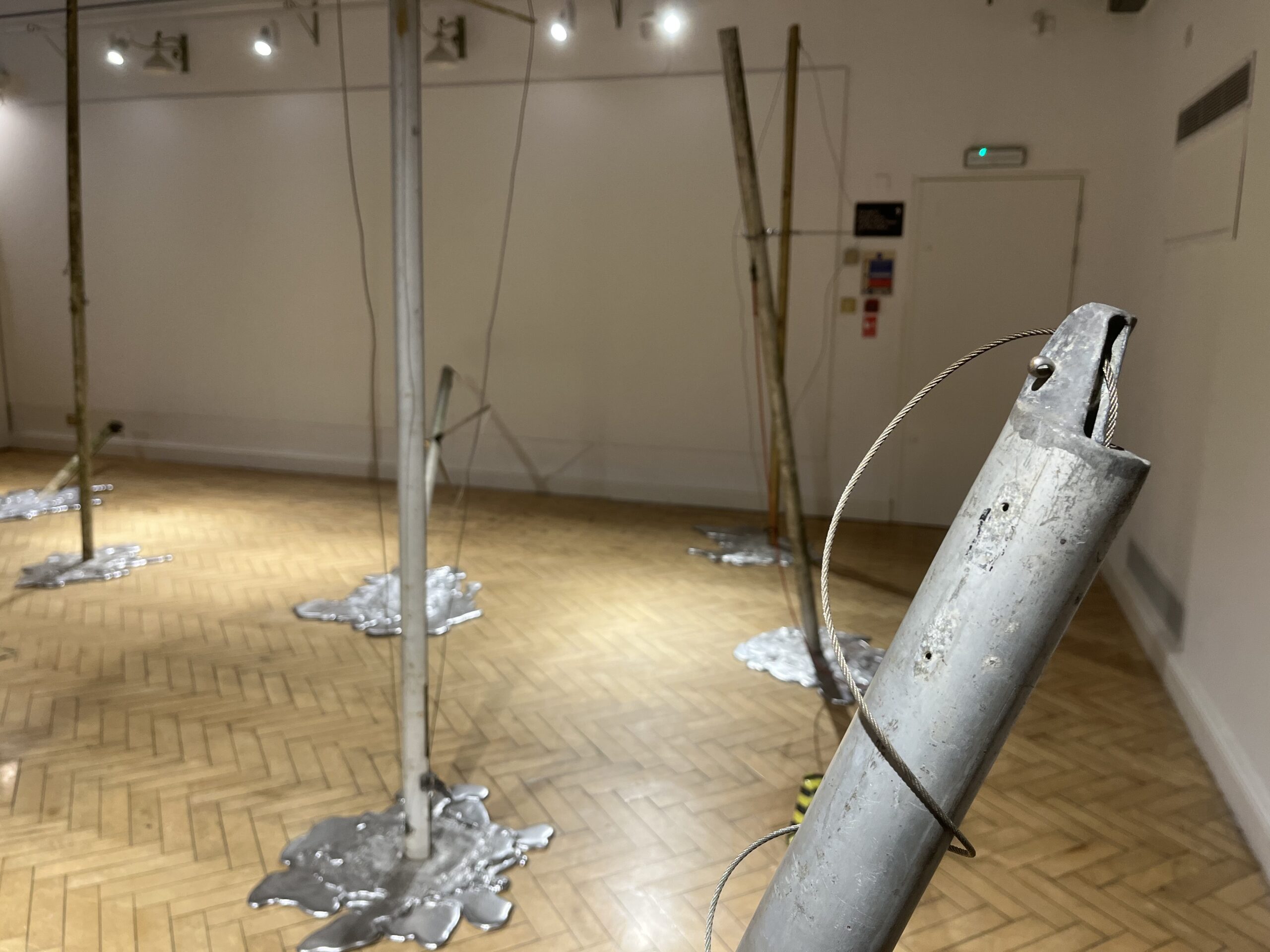
    Tom Dale is a left field sculptor who modifies found objects in order to derive poetry, comedy and at times like this tragedy from their unexpected appearance in a gallery. His latest finds are 13 unwanted yacht masts, which he has partially melted from the base up so that each of them looks as if submerging into a molten metal sea. Shafts are weathered. Rigging hangs slack. Aluminium swells in puddles on the parquet gallery floor. It has a texture like oil on water.

    But the masts are only more or less upright. Together they appear to lean about like crooked teeth or an array of tombstones in a horror film. Once seaworthy, then scrapped, now repurposed as an exhibition of contemporary art, these masts have caught the prevailing winds of a town where the shops are closed and boarded. Even in bright sunlight, the high street, which runs directly from the ferry dock to the gallery, is bewildering.

    Perhaps it is as a result of the decline of Britain as a seafaring nation. Perhaps it owes its poverty to the long years now that Britain has somehow survived without a naval battle. Or perhaps it’s an unfortunate, sadly unforeseen side effect of the UK’s post-2008 austerity politics. One expects it’s all of the above.

    But rather than neglect or redundancy, what this exhibition suggests is a roaring furnace. The dangerous, hostile environment in which this work came into being was an inferno rather than a balance sheet. Capitalism, as far as I can see, has more in common with a binfire these days, than it might have ever had with reasoned economics.

    Margaret Thatcher loved Gosport. She would pop down for the annual commemoration of her war in the Falklands, a fact learned from the rich display of local history in the museum here. It’s a history the artist flags up directly even as he dissolves its outward form. In a lowering tide all boats sink. And what to do? Despite the reference to mechanisation in the show’s title ,there is no longer even enough light industry to keep this town buoyant.

    I would however recommend a visit, with an option for the total package: the ferry trip; the peace in the museum cafe; the spectacle of the art. To see these yacht parts becalmed and brought into a former school hall is to walk into a three dimensional evocation of the soul of this town. And you’ll get to appreciate keeping your feet dry, at the same time, even as you immerse yourself.

    Machine Borders can be seen at Gosport Museum & Art Gallery until 3 May 2025.

    contemporary art

    Daniel Pryde-Jarman at Sidney Nolan Trust

    September 29, 2021

    Sidney Nolan Trust is a bucolic arts centre, which nestles in a valley carved out by a glacier. Along with acres of green land, the late Australian artist’s Herefordshire estate comprises a calmly ramshackle residential home, a preserved studio overstocked with spray paint, and an outlying barn which has become a gallery to show, largely, Nolan’s work. At time of visit, the show was dedicated to prints made in response to Auschwitz.

    Daniel Pryde-Jarman, whose exhibition intervenes economically in the surrounding grounds, has responded to lesser evils. But whereas the impossibility of representing the holocaust is a commonplace observation, Pryde-Jarman does make visible a number of otherwise hidden facets of imperialism: be that American, Soviet, pre-Soviet or post-British.

    His sculptural show is characterised by a simplicity of form and a broadly shared aesthetic where stark angularity contrasts with the vernacular architecture, and where the organic finish tends to blend in. His key motif is a doorway and, if you include an opening framing his installation in the Granary, one counts almost a dozen doorways across his four works in the show. Eight of these are in a state of collapse; two lead nowhere. And to step through the empty frame in the Granary would be to find yourself in mid air.

    Most of the doors are arranged in a small field by the Centre’s car park. Their charred wood frames, empty, lean left and right and invite the eye to navigate a grassy field enclosed with barbed wire, and they offer nowhere to rest. There is an aspect of horror to the emptiness of these doors: no interior; there is no shelter from the drizzling grey skies. Picking my way across the spongy grass, I break a cobweb to step through one of these portals and wonder what my participation means; because these frames are haunted by a dark, unlikely referent.

    This work is called Flood and all seven of these openings are based on images found online which showed the aftermath of a flood at a settlement made to train soldiers at Fort Irwin in the Californian desert. These doors look like doors which look like the doors of a generic street of a town in the Middle East. Until the 2013 monsoon, US military could hone their lethal abilities storming terrorist living rooms and smoking out bedroom snipers. Here the remains of this sophisticated folly are abstracted with little or no comment. In our remote corner of the Welsh borders, where the beautiful villages seem ever tranquil, the reality of the so-called war on terror is made obliquely tangible here, as is the weirdness.

    The Granary is a small, raised barn with swept flagstone floor and solid timber rafters. The space looks newly restored, but obsolete farm machinery, mounted on the wall, wears an orange patina of age. Equally antique are the three squat monoliths, prefabricated by the artist in his Hereford studio. Two of these taper, like obelisks; the other is stepped like the Cenotaph; and all three have a rough, aged concrete finish. But tap one with a knuckle and it returns a hollow knocking sound. They represent empty plinths and all three have the potential to return to that function. In this storage place for grain, they stand dormant.

    As before, this piece has a parallel in the outside world, which Pryde-Jarman came upon, online. Google Streetview meant that he could base these plinths on proportions seen on originals in Eastern Europe, which have fallen into disuse, having been designed to support statues of Lenin. Pryde-Jarman was working with plinths prior to events in Bristol in June last year. We know now statues can be toppled, but plinths are hard to destroy. Here they offer a sense of both hope and danger that these will be restored or repurposed. The three forms, arranged at irregular angles, fill this barn with potential and tension.

    Back outside, another vacant concrete monument rises more than three metres above the Sidney Nolan apple orchard. It is rendered to look solid with a finish as stony as that of the plinths. And, as a narrow, terraced house, it encases an open doorway, with an unglazed window on the floor above. But this structure is askew, like the ghostly doors of Fort Irwin. And since the window opens onto the sky, this structure fools no one. One can pass behind the standing stone to inspect the plywood frame and admire its workmanlike artifice.

    That said, this piece puts us briefly in the slippers of Catherine the Great. She is said to have gazed from her carriage upon entire villages erected in this way, like theatre scenery, to give the false impression her subjects were living well. This elaborate subterfuge was the work of her closest advisor, friend and lover, Grigori Potemkin, who has since given his name to any device, from flashmob to state news broadcast, which portrays a happy and contented population for propaganda purposes. This piece too goes by the title Potemkin.

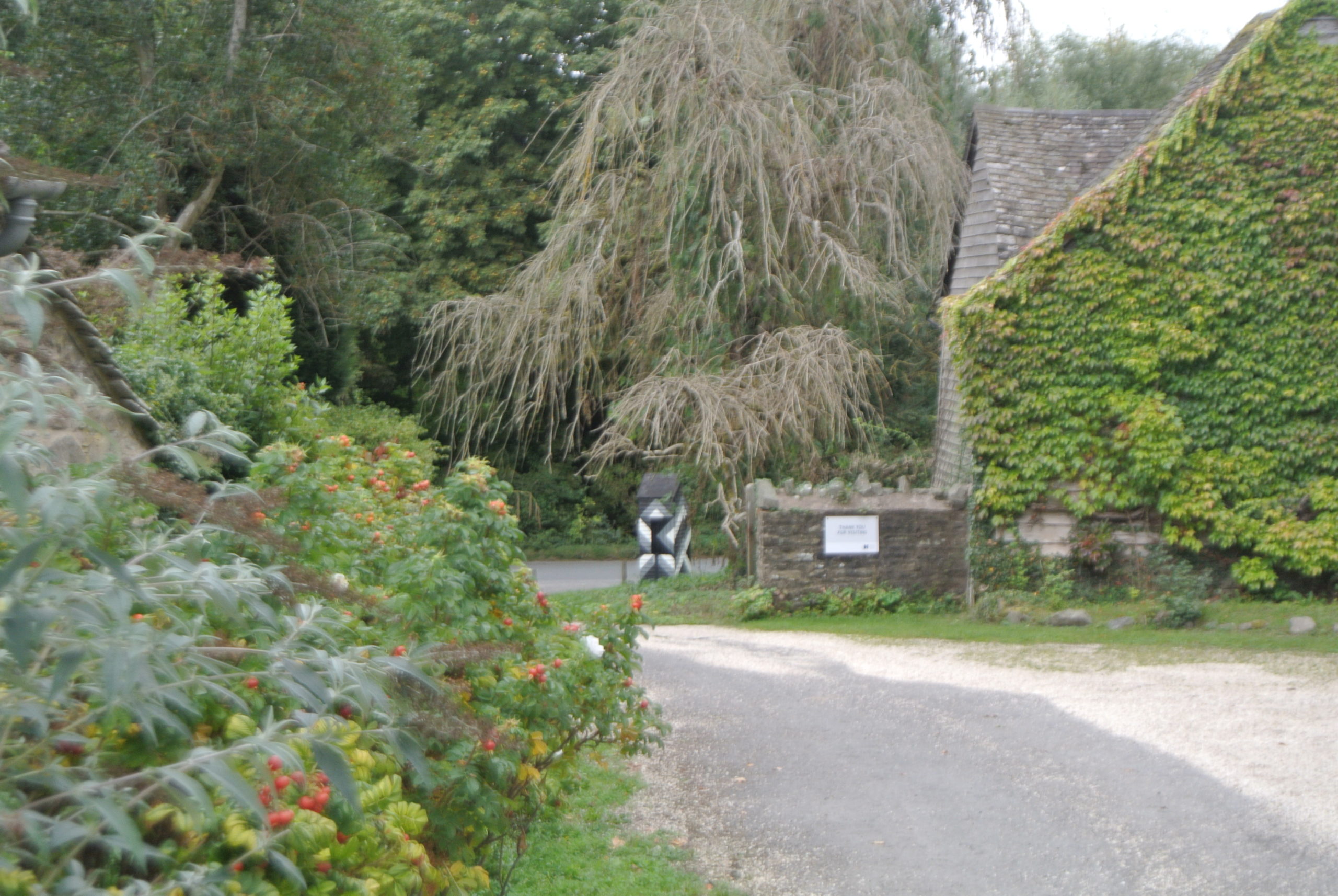
    Two final doorways which open onto closed space are to be found in a pair of sentry boxes stationed at the entrances to the centre and to the car park. Whereas the previous works embody ideas, and have been finished by charring, rendering, or concrete, the paintwork on the final piece is the concept itself. The sentry box is put together like a garden shed with gable roof and slats. But it is painted with interlocking, dynamic black, white and grey shapes, which draw the attention and disturb the vision. The military don’t really go in for decoration (aside from medals), so this piece of loud, bright, albeit monochrome, security infrastructure is a wry oddity.

    Dazzle camouflage, of which this is an example, was first used by ships in WWI, intended to confuse an opponent as to direction and speed. Its deployment here on a static sentry post, which no one is likely to shoot at, at a remote arts centre, rather than a working barracks is pleasantly baffling. One also wonders about the structure, why do sentries require boxes? With their benches, near redundant, inside, these two guardhouses are dwellings so small as to be pointless. This is toy-like architecture that lampoons its occupant.

    This keen sense of the ridiculous reverberates strongly: from the vainglory of 18th century Russia through to the 21st century war games of the most powerful army on earth. In a world gone proverbially mad, these extreme follies – Arab villages in the Mojave desert; temporary towns in the Crimea; the wholesale decommissioning of plinths; self-conscious sentries – well belong. But their appearance here at Sidney Nolan, where the pace is slow and the setting idyllic, makes visible a threat to all.

    It brings to mind of Poussin’s classically classical painting, Et in Arcadia Ego. So reads a stone inscription, on a tomb, found by some shepherds: ‘death is in Arcadia too’. Pryde-Jarman delivers a similar warning, but with a light touch in keeping with our absurd times.

    Daniel Pryde-Jarman was exhibiting at Sidney Nolan Trust, Presteigne, Herefordshire: May-September 2021.

    contemporary installation

    Karla Black, Waiver for Shade (2021)

    July 10, 2021

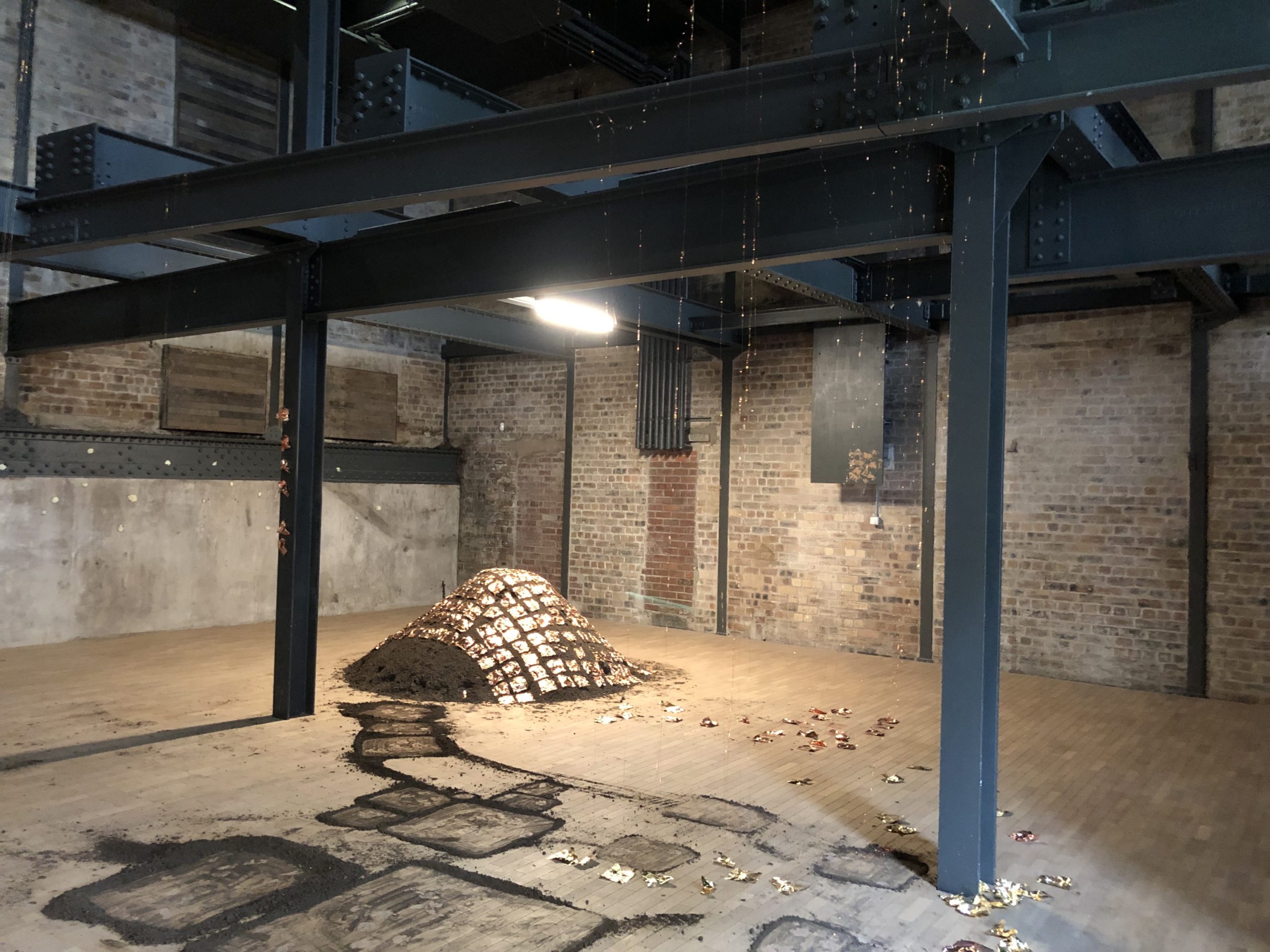
    Taking a break from her hallmark candy-coloured sculptures, Karla Black has responded to a former warehouse at Fruitmarket with an installation comprising a ton or so of black soil.

    The light is low, here, in the gallery’s new space. But the minimal illumination is amplified by the introduction of gold and copper leaf, a multitude of seeming confectionery wrappers.

    Most of the work is on the floor or walls. The crumpled leaf is scattered; the soil creates an effect of paving. But the conventions around installation art proscribe actually walking here.

    At the back of this stage, a mound of this dark earth looms. Foil wraps decorate it, row upon row like contour lines. They seem to armour this indistinct form. They certainly aestheticize it.

    And the whole scene is first viewed through a barely visible veil of thread. All one sees are raining points of illumination where the ambient light catches the filaments’ gilding.

    It’s enchanted, but also filthy. Soil is a base material. Art is alchemical. Those who seriously collect it might also be interested in this pill that lets you shit glitter.

    Or they may be intrigued by the prospect that mining companies could soon be able to extract minimal amounts of gold, vanadium and copper from human waste.

    They would almost certainly enjoy a gold toilet, and of these there have been more than one. Lost in a gold-toilet rabbithole on Wikipedia I came across this quote from Vladimir Lenin:

    “When we are victorious on a world scale I think we shall use gold for the purpose of building public lavatories in the streets of some of the largest cities of the world.” 

    The revolutionary point here is that gold is too often the cause of war, and Lenin hoped such toilets might educate people about the 10 million lives lost in WWI.

    There are plenty of ways that great art might hold what glitters in tension with the earthly, but few examples quite as theatrical and artful as this one by Karla Black.

    This piece can be seen at Fruitmarket, Edinburgh, until 24 October 2021. See gallery website for more details.

    contemporary art

    Interview: Sahej Rahal

    July 30, 2016

    sahal

    The artist appears to have a simple and urgent proposition: to render the past absurd is to neutralise the rhetoric of the political right.

    Without a golden age to hark about, no one can promise to make America, the UK, or India ‘great again’. And we can instead progress to a state of internationalism, equal rights, economic parity and perpetual peace.

    Rahal lives in Mumbai, but he points out that the whole planet is “kind of a scary place to be working, globally”. He is, however, welcome in the North West, where for the duration of the 2016 Liverpool Biennial, his sculpture and film is being shown across three sites.

    We met at Cains Brewery, a cavernous space for art enjoying a good year. It is however scruffy, and Rahal’s work looks in keeping with the general state of repair. It is the first thing a visitor sees: nuggets of clay arranged on trestle-like tables; bits of scaffold, locally sourced, covered in clay; and black-box monitors which appear to emerge from the mess on which figurines breathe or practice with lightsabers.

    “I’m a huge nerd and I obviously have all these Star Wars references”, the artist cheerfully informs me. But like many contemporary sculptors, he aims both high and low, looking to Jorge Luis Borges for ”vast metaphysical narratives”, and for that writer’s concern with “creating this itinerary of our culture”.

    In short, this itinerary is dystopian. The artefacts presented appear fresh from some archaeological dig. But what kind of half-formed world do they conjure up? A: it is a world run by idiots in which technology has failed us and we have forgotten basic craft skills. And that seems to me the worst of all possible worlds.

    “I like the fact that these characters, or these objects of clay could somehow become like harbingers of something, you know?” Rahul tells me as we contemplate his pottery-based triage stations which all appear to somehow breathe in the light of the moving image work.

    He also says: “I’m more interested in putting them together to form meaning… from these absurd things, which are beyond reason in a certain way. In that meaning-making ritual that people perform, how do we create allegiances? How do we create bonds across space-time?”

    An interest in travel and time travel chimes in well with the 2016 Biennial, which is a nebulous animal in which Monuments from the Future is one of six official themes. You may find, as I did, that as you come across Rahal’s work more than once, you build a picture of what might be becoming. 

    It is a picture of a primitive time around the corner. Rahal expresses concern about right wing  governments that have followed the Arab Spring, the rise of presidential candidate Donald Trump, and the hate-filled effect of Brexit here in the UK.

    If politics is performative, the artist has another highly political aspect to his practice. Rahul stages improvised, ritualistic performances which offer only “fleeting, fragmented glimpses” of a narrative, and which change gear according to pop cultural requests from his viewers.

    “Even I don’t have a bead on [these],” he tells me. “Essentially, what’s interesting for me is that I’m also a viewer as well.” One supposes that in these powerless times, we are all to a degree little more than viewers, even as we march, occupy, tweet or blog.

    But perhaps in the light of our political horizons, we’ll do well to maintain any civilisation at all.

    Despite everything, Rahal is making the most of circumstances: “Earthenware has so much meaning to our origins so I’m drawn to that, but saying that it’s also so much fun to just dive into clay and get mud all over me.”

    As well he might, since in Summer 2016 we are all up to the neck in it.

    Liverpool Biennial runs until October 16 2016. I reviewed it for Culture24 here. See artist’s website for more images.

    installation art

    Annette Messager, Les interdictions (2014)

    January 30, 2016

    messager

    As 1968 begins to pass out of living memory, the date begins to lose its power. Sadly. We are by now a long way from barricades and a long way from a revolutionary tipping point. It seems.

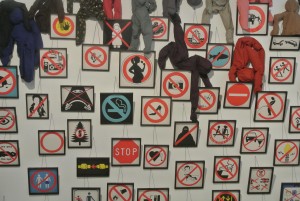
    Perhaps to keep the memory alive and honour the students who could have brought down a Western government, this artwork by 72-year old Messager comprises 68 prohibition signs. (’68!)

    We can only assume the artist had some fun redesigning these interdictions. How else could we actually enjoy the sight of a wall plastered with the evidence of the human bent for authority?

    As things stand you might well relish the comedy value. It has been decreed from on high that in the gallery today, we we cannot feed monkeys, have sex in spas, or drive wearing a burqa.

    Says Museum director Barbara Forest in the catalogue: “The absence of context renders the signposting more derisory, more absurd, more ridiculous, more grotesque and more serious”.

    Of course the rules here don’t apply. Artists are traditionally people who break rules, rather than people who enshrine them. So these handmade prohibitions are fairly dripping with irony.

    All but one of the signs is based on a real world referent. The exception, which proves the rest of the rules, is top right: no prostitution. Another tradition of artists is that you don’t sell out.

    But since this work is a roundabout celebration of freedom, that must include the freedom to capitalise on your artistic talents and, in one way or another join the establishment. 

    There is a figurative element to this installation. It features more than a dozen mannequins, more than a dozen child-sized snowsuits. None of us chafe against rules more than children do.

    Yet do we not make a good many rules for the good of our young? Messager may evoke 1968 in this major work, but that’s not to say she might not be very ambivalent about the laws of man.

    Les interdictions can be seen in Annette Messager: Dessus Dessous at the Musée des beaux-arts Calais until 15 May 2016.

    contemporary art

    Bob and Roberta Smith, Letter to George Osborne (2015)

    November 26, 2015

    wmg_bob_1a

    You cannot help but wonder: did a 50-line letter painted onto the front and rear of a pair of white radiator units have any incidental effect on government policy? Did it really spark a heated debate?

    Beyond the headlines about tax credits, the Autumn Statement revealed that the Arts Council can also breathe a sigh of relief and consider its budget protected for five more years.

    This is not the beef raised by Smith, who talks tuition fees, the threat to art schools from property developers, and the culture of consumerism which now extends to the student experience.

    None of this has changed. But the artist signs off with a message which may just be getting through: “I THINK THE ARTS ARE REALLY ABOUT SAVING HUMANITY”. What did Osborne think of that?

    Certainly the arts are a cheap way to save humanity. Arts Council England cost £349 million in 2014; to save humanity with a replacement for Trident will cost, according to CND, some £100 billion.

    There are dangers in cynicism, however. A positive and polite reaction to this news about the Arts Council could be more likely to encourage the Conservative government in this cultural direction.

    But giving credit is not abject gratitude. As Smith says, in another set of emphatic capitals: “ART IS YOUR HUMAN RIGHT”. Just as education is a right, welfare is a right, and healthcare remains so.

    As inhumane as austerity is proving to be, the left should remember we don’t have a monopoly on humanity. Again, appeals to this quality may prove more tractable than immediate class war.

    That could be why Smith’s naivety, both in tone and execution of this open letter, strikes an effective chord. It treats the Chancellor as a reasonable human. It invites him to enjoy contemporary art.

    But this is also is a bit of a joke. Smith is only an artist; he is not the head of a bank. The banker uses headed notepaper, and not beat-up used radiators. So to who does the future belong?

    contemporary sculpture

    The Chapman Brothers, Sturm und Drang (2015)

    June 5, 2015

    sturm und drang

    To hear this described, you might imagine something on a more imposing scale: a blasted tree hung with bodies of soldiering age, the reconstruction of a Goya etching.

    But the truth is, Sturm und Drang looks a bit like a toy. This wicked bronze plays out in the shadow of the viewer, as if these dead were sent into battle in our name.

    And that’s not a million miles from the way in which wars operate. How many are to be killed on our behalf in our comfortable lifetimes? If we consider ourselves moral, the joke is on us.

    Or if we consider ourselves rational, these grinning corpses might say otherwise. From the 1760s to the 1780s, Sturm und Drang was a German movement which celebrated passion and nature.

    But the artists don’t seem like Romantic (or even proto-Romantic) types. This piece is ironic about Goya, ironic about German literature, and ironic about anyone who takes the above seriously.

    Cadavers are not the stuff of enlightenment statuary. This piece presents you with skeletal forms which you could play like a xylophone and entrails they are yet to relinquish to dogs.

    Since the entirety is in monochromatic bronze, the forms emerge slowly. The faces come to you as goblin masks; maggots are having a time of it. The Chapmans have been to the joke shop.

    That’s one place I would love to be a (plastic) fly on the wall. It says something that two of our most fêted artists source their materials from a realm of cheap costumes and tricks.

    A pity that’s where we’ve ended up, and nowhere could be further from the culture wars of the 18th century. That’s the Chapmans for you: nihilists who must only get out of bed to laugh standing up.

    Sturm und Drang is now on permanent view at Ekeberg Sculpture Park, Oslo.